The 4th of July is nearly here, and in America that means fireworks and barbecues. (In England, it means I'll be giving my talk 'How America Saved the English Language' at the Skeptics in the Pub at Tunbridge Wells. Hope I'll meet some readers there. And that no one will throw things at me.)
The old standbys of American barbecues are hot dogs and hamburgers. I've written a bit about hot dogs before, when I was wondering whether a UK company had misunderstood the term red hot. But the (orig. AmE) term hot dog itself is used rather differently in the US and UK, as my sad tale will reveal. A Californian-in-the-UK friend and I took our kids to an event in a local arts complex. There was the option to bring a picnic lunch, but we'd seen it advertised that they were also serving hot dogs. Get lost, picnic lunches! We're having hot dogs! We ordered some with 'Back to the Old Skool' (their words/spelling) toppings: ketchup and yellow (a.k.a. American) mustard. What we received was this thing-in-a-roll.
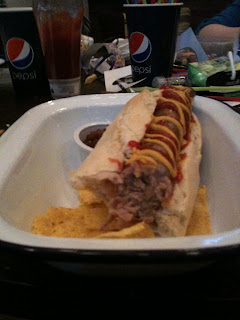
I believe (but I may be wrong) it was a Cumberland sausage. The roll was chewy and baguette-like. It also took forever to arrive, so we were already grumpy, and then we were disappointed, for this is no hot dog, from an American point of view.
We can see hints of why we were disappointed if we compare British and American dictionary definitions of hot dog.
The American Heritage Dictionary says:
The same kind of thing happens with (orig. AmE) burgers. The British focus on the bread: a burger is a cooked thing served in a round bun (but they'd be more likely to call it a roll--see the old baked goods post). So, order a chicken burger at Nando's or Gourmet Burger Kitchen, and you'll get what Americans would call a chicken breast sandwich. For Americans, a burger is a (chiefly AmE) patty made of (AmE) ground/(BrE) minced meat, so we can be heard to express surprise when the chicken burgers we order in the UK are chicken breasts. (Not necessarily disappointed, but surprised. One doesn't hear chicken burger that much in the US, but turkey burger is fairly common--and always ground/minced.)
[My colleague Lynne C's first comment here says what I should have. BrE uses beefburger for the patty. To my American ear, that always sounds redundant. And kind of unconvincing. If you have to tell me it's beef, should I trust the burger? In the wake of the horse meat scandal, maybe not!]
 In fact the 'burger' is so much associated with the meat that (orig. AmE) hamburger can also be used in AmE to refer to ground/minced beef even before it's cooked. Hence Hamburger Helper, and its 'Add hamburger' in the top right corner of the package. Here hamburger is a mass noun, not a countable patty.
In my part of the US (at least) hamburger is often shortened to hamburg (in either the 'ground meat' or 'ground-meat sandwich' meanings), as evidenced by the photo below, taken a couple of years ago in Sodus Point, NY. (Salt potatoes, for the unfortunate uninitiated, are an upstate New York treat.)

I will be missing all this on the 4th of July, but the kind people at Tunbridge Wells Skeptics have promised cake. Independence Day is a birthday of sorts, I suppose.
In other news:
 We had decided to have burgers as a nod to the 4th of July, and my friend was torn about having the chicken one, since she knew it was not American to call it a 'chicken burger'. (It was indeed a breast fil(l)et--I'd put away the phone/camera for the meal, which I only half regret.) But since it was 'Cajun' we agreed it was 'American enough'. All of these had cheese on them, by the way, but none are called 'cheeseburgers'. There's a US/UK cheeseburger difference to mention here, though: in the UK, the cheese is often not melted on a burger. In fact, at one place I go, they serve the burger on one half of the bun/roll, and the other half has all the extras stacked on it, including cold cheddar. In the US, not every place would put the cheese on the burger while it was cooking, but at least it will have been put right on after cooking, so that it melts a bit.
I had the 'steak burger', although I'm supposed to be reducing my beef intake for environmental reasons, and I wish to report: it was one of the best seasoned burgers I can remember having. Thanks, Wells Kitchen!
Postscript (30 July 2013): It seems I can't leave this post alone. I thought of it again when wandering through Poundland (one of the UK equivalents of a US 'dollar store') and spotting this evidence of UK use of hot dog for the sausage without the bun:
 Americans are often surprised by the hot dogs in jars or (orig. AmE) cans/(BrE) tins in the UK, but here they are. Even more fun is to see this brand's "American" range. Now, in AmE I might call these 'little hot dogs', but I'm more likely to call them cocktail franks or cocktail wieners.
The old standbys of American barbecues are hot dogs and hamburgers. I've written a bit about hot dogs before, when I was wondering whether a UK company had misunderstood the term red hot. But the (orig. AmE) term hot dog itself is used rather differently in the US and UK, as my sad tale will reveal. A Californian-in-the-UK friend and I took our kids to an event in a local arts complex. There was the option to bring a picnic lunch, but we'd seen it advertised that they were also serving hot dogs. Get lost, picnic lunches! We're having hot dogs! We ordered some with 'Back to the Old Skool' (their words/spelling) toppings: ketchup and yellow (a.k.a. American) mustard. What we received was this thing-in-a-roll.

I believe (but I may be wrong) it was a Cumberland sausage. The roll was chewy and baguette-like. It also took forever to arrive, so we were already grumpy, and then we were disappointed, for this is no hot dog, from an American point of view.
We can see hints of why we were disappointed if we compare British and American dictionary definitions of hot dog.
The American Heritage Dictionary says:
The Oxford English Dictionary says:1. A frankfurter, especially one served hot in a long soft roll. Also called red-hot.
1. orig. U.S. A hot sausage served in a long soft rollSee what's going on there? For Americans, a hot dog is a particular type of sausage. It's typically served in a long, soft roll, but that's how it's served, not what it is. What it is is a type of sausage. For the British, hot dog is a way of serving a sausage. It is essentially (in the American use of this word), a type of sandwich, not a type of sausage.
The same kind of thing happens with (orig. AmE) burgers. The British focus on the bread: a burger is a cooked thing served in a round bun (but they'd be more likely to call it a roll--see the old baked goods post). So, order a chicken burger at Nando's or Gourmet Burger Kitchen, and you'll get what Americans would call a chicken breast sandwich. For Americans, a burger is a (chiefly AmE) patty made of (AmE) ground/(BrE) minced meat, so we can be heard to express surprise when the chicken burgers we order in the UK are chicken breasts. (Not necessarily disappointed, but surprised. One doesn't hear chicken burger that much in the US, but turkey burger is fairly common--and always ground/minced.)
[My colleague Lynne C's first comment here says what I should have. BrE uses beefburger for the patty. To my American ear, that always sounds redundant. And kind of unconvincing. If you have to tell me it's beef, should I trust the burger? In the wake of the horse meat scandal, maybe not!]
 In fact the 'burger' is so much associated with the meat that (orig. AmE) hamburger can also be used in AmE to refer to ground/minced beef even before it's cooked. Hence Hamburger Helper, and its 'Add hamburger' in the top right corner of the package. Here hamburger is a mass noun, not a countable patty.
 In my part of the US (at least) hamburger is often shortened to hamburg (in either the 'ground meat' or 'ground-meat sandwich' meanings), as evidenced by the photo below, taken a couple of years ago in Sodus Point, NY. (Salt potatoes, for the unfortunate uninitiated, are an upstate New York treat.)

I will be missing all this on the 4th of July, but the kind people at Tunbridge Wells Skeptics have promised cake. Independence Day is a birthday of sorts, I suppose.
In other news:
- I'm interviewed about bloggy things in the Chicago Manual of Style's online 'Shop Talk' feature this month.
- More 'How America Saved The English Language' talks are booked. If you're near any of these places, I hope we might get the chance to say 'hello':
- 2 September: Ealing Skeptics in the Pub
- 8 September: Ashford at the Phoenix pub (part of Kent Skeptics in the Pub Roadshow)
- 18 December: Eastbourne Skeptics in the Pub
- I'm also pencil(l)ed-in as a speaker at the Brighton Catalyst Club in October (2nd Thursday of the month). You can expect linguistics, but possibly not an AmE/BrE focus. (We shall see...)

I had the 'steak burger', although I'm supposed to be reducing my beef intake for environmental reasons, and I wish to report: it was one of the best seasoned burgers I can remember having. Thanks, Wells Kitchen!
Postscript (30 July 2013): It seems I can't leave this post alone. I thought of it again when wandering through Poundland (one of the UK equivalents of a US 'dollar store') and spotting this evidence of UK use of hot dog for the sausage without the bun:


