judg(e)ment

At some point in my American education, I learned that judgment was an American spelling and judgement was the preferred British spelling. Ditto acknowledgment and acknowledgementBut then I moved to England and grew up (possibly in that order) and reali{s/z}ed that nothing is ever that simple. (Though I see some poor souls [read: schools] on the internet are happy to promulgate the simplification.)

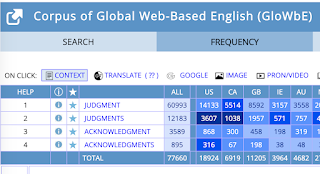
The e-ful versions of these words show up as 'more British than American' in the GloWbE corpus, but it's pretty clear from the numbers that it's not a straightforward difference. Here are the raw numbers:


with the E
without the E


And here, more readably, are the proportions. BrE does prefer the e-ful versions, but not absolutely. AmE has completely mixed feelings about acknowledgement and while it mostly prefers judgment without that e, it still has 25% e-ful judgement. (Yes, I know that there's still an e in the version I'm not calling e-ful. Don't be difficult. You know what I mean.)

acknowledgement AmE 56% BrE 77%, judgement AmE 25% BrE 63%
(includes singular and plural)


Now, you might look at this kind of thing and think: it's those Americans getting rid of letters again. Noah Webster, to whom many attribute American spelling habits, was not a fan of 'silent e' and tried to get rid of it elsewhere. (For example, he wanted to spell improve as improov.) But judgment is no Websterian Americanism. The Oxford English Dictionary tells us that though judgement had an e early on (coming, as it did, from French jugement), the e had started to drop out by the 16th century, and judgment was the prevailing spelling in by the end of the 17th century. Both judgment and acknowledgment are e-less in Samuel Johnson's 1755 dictionary

It was only in the 19th century that the e-ful judgement regained popularity in British contexts—I assume acknowledg(e)ment followed suit, but the OED has less info about that word. It's not surprising that the e gained traction, since using the e before the -ment suffix does some helpful things: 
  • it keeps the spelling of the root word (judge, acknowledge) intact
  • it signals the 'softness' of the g before the suffix ('soft' g's typically only go before e, i or y)
  • it avoids a weird letter combination: dgm
But you'd never know that judgement is "British English" if you looked in some places. Here's what the spelling is like in the UK Parliamentary record. Pretty darned e-less.


That's because legal language tends to be more conservative. In British law, judgment has no e.

This makes judg(e)ment just one more British word that has a spelling/form variation depending on professional context:

Some of those splits in BrE spelling are due to the influence of AmE, but in the case of judg(e)ment, we have (non-legal) BrE innovating while AmE mostly didn't change. If either variety is influencing the other, it might be BrE's allowance of those e's in judgment and acknoweledgement that's causing AmE to be more tolerant of the longer spellings. 

Read more

flapjacks and pancakes

I cannot believe I've never written a post about the word flapjack. So here it is. 

In AmE, flapjack is a synonym for pancake, as is hotcake. Hey, it's a big country. We're allowed to have lots of words for things. 

Here in the south of England (at least), those things are often called American pancakes to differentiate them from the more crêpe-like English pancakes (often eaten with lemon juice and sugar). Then there are Scotch pancakes, also called drop scones, which are very much like American pancakes. I've seen one site that claims that Scotch pancakes have sugar in them but American pancakes have butter in them, and I can tell you that my American pancakes have a little sugar and no butter (but some cooking oil) in them, so I'm not believing that website. I'd say the main difference between Scotch pancakes and American ones is the size, with Scotch pancakes being closer to what are called silver dollar pancakes in AmE, which can have a similar circumference to a crumpet or (English) muffin—that is to say bigger than a silver dollar. (All links in this paragraph are to recipes.)

A few immigrant pancake notes:

  • I was really surprised (when I arrived 22 years ago) to find that in the UK one can buy cold Scotch pancakes in a UK supermarket. I'd never seen such a thing in the US. Maybe frozen ones for heating up, but not pancakes in the bread aisle of the supermarket. Even more surprised when I first saw someone eating them cold, straight out of the (more BrE) packet.


  • If you order "American pancakes" in England they (a) generally won't come with butter (gasp?! sob!!) and (b) will be covered with so much sweet stuff that you will get a cavity before you've swallowed the last bite. At least around here, the pancakes themselves are pretty sweet, then they tend to put the maple syrup on before they serve it AND dust them with a ton of (AmE) confectioner's sugar /(BrE) icing sugar. I have mostly learned better than to order them, but my child hasn't. 
  • These days, with American pancakes being much more common in Brighton, the actual pancakes can be pretty good (though, as I say, often too much sugar in the batter). When I first moved here and only a handful of places served them, they were invariably undercooked in the middle. I assume this was because the cooks had been trained in English pancakes and couldn't believe a pancake could take so long to cook. The best ones in Brighton are now made by my English spouse, who's taken every food I've ever cooked for him and made it his mission to master it. 
Now, for BrE flapjacks. A completely different animal: a (BrE) tray bake made of oats, butter and usually golden syrup (click on the links for where I've covered those terms). I have seen recipes that call for honey instead of the syrup—you need something gloopy and sweet. If you want to get fancy, you can put other ingredients in, dried fruit being the most common addition. Here are some recipes

BBC Good Food Easy Honey Flapjacks


The closest things in the US are probably granola bar-type things, but they don't tend to be so solidly oaty. What the US does have, though, is oatmeal (raisin) cookies.

I've heard various American exchange students refer to flapjacks as one of the best things about England. The appeal eludes me. I'll eat one to be polite, but I'll gladly ignore them. I count that as a win. Any sweet thing that I can resist is a good kind of sweet thing. 


Read more

US-to-UK Word of the Year 2021: "doon"

 Click here for the preamble to the 2021 Words of the Year and the UK-to-US word.

As I discuss in the post at that link, 2021 was a dry year for US-to-UK borrowings. Some might say that's because BrE is already saturated with them. But it feels to me like the UK is feeling a bit more insular these days, and paying less attention to Biden's USA than to his predecessor's, possibly because it was more fun to pay attention to another country when one could pretend their government was messier than one's own, possibly because everyone was watching Korean and French tv.

So, I don't really have a US>UK Word of the Year this year. None were nominated. But I do have a pronunciation.

US-to-UK Word Pronunciation of the Year: Dune

In most BrE dialects (the notable exception being Norfolk—and now probably more older, more rural Norfolk), the spelling du (and tu and su) involves a palatal on-glide, which is to say a 'y' sound before the u. People with this pronunciation would have different pronunciations for dune and doon, whereas for Americans they are generally the same. I've written about this difference before,
here.

The 2021 film Dune had everyone talking, though, and sometimes BrE speakers were using the AmE pronunciation. It's a proper name, after all, and proper names can defy spelling–pronunciation rules. It's kind of like how many BrE speakers do not pronounce the title of Kevin Smith's film Clerks as "clarks". It would feel weird to pronounce the word differently from the people in the film. 

Emma Pavey nominated this pronunciation on Sunday, when I had just heard my London-born sister-in-law say "doon" in reference to the film. And so it is thanks to her that we have any US-to-UK 'of the year' for 2021. She says:

People kept calling the movie by its full name 'Dune or doon or however we're supposed to say it'.
 
This Australian YouTuber gets pronunciations from the film's cast and director:


Meanwhile, Americans tend not to understand what the fuss is about. 


A US-in-UK friend said pretty much the same thing in the Facebook thread where Emma nominated the pronunciation. If you're not sensiti{s/z}ed to the 'u' versus 'oo' distinction, it just passes you by. But for many BrE speakers, dune isn't just "dyune", it's "June". That's what happens when that d-sound and that y-sound mix. 

I doubt that this will have much effect on the word dune. (I can't say I've been around any BrE speakers who've needed to say it in some time.) But at least some BrE speakers are looking forward to the next instal(l)ment of Denis Villaneuve's Doon

That's it for 2021. Send me your nominations, as you encounter them, for 2022!

Read more

UK-to-US Word of the Year 2021: university

The annual preamble  (you can make that rhyme if you try hard enough)

Each year since 2006, this blog has designated Transatlantic Words of the Year (WotY). The twist is that I choose the most 'of the year' borrowings from US-to-UK and from UK-to-US. 

This year's WotY posts are a bit later than usual. Had I had strong ideas about which words to crown, I might have written the posts during my Christmas (BrE) holiday/(AmE) vacation, but I didn't, so I thought I'd wait till I was on the plane back home on New Year's Day. Except that I didn't get on a plane on New Year's Day, and the travel woes got more and more complicated after that. A few days' recovery was needed. So I'm taking the opportunity to announce my Words of the Year on the Zoom programme/show That Word Chat on 11 January, and this post will post at that time.

During the 2020 WotY season, I was very interested in the variability of the language for our universal experiences of the early pandemic. Isolation, lockdown, and quarantine were Words of the Year from different English-speaking nations, but generally referred to the same thing. (In the latest issue of the journal Dictionaries, which I am hono(u)red to edit, Wendalyn Nichols and Lewis Lawyer tell the tale of how the WotY process led Cambridge Dictionary to record new senses for quarantine.)  By the end of the year, there was hope of a vaccine, a word that ended up being or inspiring several dictionaries' 2021 Words of the Year. But BrE jab had already poked its head into the US in December 2020,  thanks to Oxford-Astra Zeneca's early vaccine successes, so it was my 2020 WotY. Since then the transatlantic vocabulary traffic has seemed rather calm. With all of us glued to our computers and our streaming services, you'd think that words would be happily travel(l)ing while we stayed (at) home. But no. It was really difficult to find clear candidates for the 2021 SbaCL WotYs. 

Eligibility criteria:

  • Good candidates for SbaCL WotY are expressions that have lived a good life on one side of the Atlantic but for some reason have made a splash on the other side of the Atlantic this year. 
  • Words coined this year are not really in the running. If they moved from one place to another that quickly, then it's hard to say that they're really "Americanisms" or "Britishisms". They're probably just "internetisms". The one situation in which I could see a newly minted word working as a transatlantic WotY would be if the word/expression referenced something very American/British but was nevertheless taken on in the other country.
  • When I say word of the year, I more technically mean lexical item of the year, which is to say, there can be spaces in nominations. Past space-ful WotYs have included gap year, Black Friday, and go missing.
And as we shall see this year, I'm even willing to go sublexical. So without further ado...


The UK-to-US Word of the Year: university (= AmE college)

Now, of course, the word university is general English and has been in use in the US for a very long time. (The University of Pennsylvania has been so called since 1779.) So rather than talking about the importation of a word, we're talking about AmE adopting a BrE sense/usage for a word form it had already. (We've certainly had WotYs like that before, including jab, ginger, and bump.)

What's changed is that US people are talking about their higher education place/experience as university more than they used to. Back in my day (I hope you read that with a suitably wavering voice), we always called it college, no matter whether the institution had college or university or institute or maybe something else in its name. And, of course, that's what Americans mostly still do.

But some Americans seem to be saying university in some of those contexts, particularly after the preposition in. The News on the Web (NOW) corpus has three US examples of in university for 2011 (from just two sources), but over 20 for 2021. The turning point seems to have been 2019, but 2021 showed us it wasn't going anywhere. Here's a poorly formatted sample (I'll try to fix it later): 

21-12-01 US

Houston Chronicle

  focused on earning money and started his journey during his academic years in university .

21-11-03 US

Human Rights Watch

  community support officer also showed him the process of enrolling in university

21-11-02 US

techcrunch.com

for-profit educational products aimed at students not yet in university .

21-10-18 US

Yahoo

  was founded by Neo Zhizhong and Alicia Cheong, who met while they were in university .

21-09-16 US

polygon.com

in-game inspiration combined with his background studying English literature in university .

21-08-29 US

syfy.com

. The tale centers around two former friends who knew each other in university .

21-07-30 US

Forbes

none of the knowledge I needed was taught in university .

21-07-14 US

newyorker.com

  West Berlin fell on November 9, 1989, when Erpenbeck was twenty-two and in university .

21-06-25 US

InfoQ

  guy now, I've learned more outside of university than I ever did in university .

21-06-13 US

VentureBeat

  , I'd heard the word " Hittite " before. I studied history in university .

21-05-25 US

soompi.com

  divorce, both of them travel back in time to when they first met in university .

21-04-30 US

Forbes

  get the whole preamble, I started in this sort of Blockchain space back in university .

21-03-28 US

East Tennessean

  and clubs are a great resource for people who are struggling with their faith in university .

21-03-20 US

Yahoo

  And so I was encouraged to cook more. I cooked for my friends in university .


But in BrE, it would be at university in most of those contexts:

GloWbE corpus GB section: At university 707, in university 55


Rather than borrowing the BrE expression at university, AmE is using that BrE sense of university in the same prepositional contexts as AmE uses college:

In GloWbE corpus US, 'in college' outnumbers 'at college' 1195:113.
One does find some relevant examples of at university in AmE, but there something interesting is happening. Note the capitali{s/z}ation in this tweet:


Forbes magazine has a couple of 2020 uses, both by non-Americans about non-American subjects—but what's interesting is the American-seeming capitalization—probably not how the BrE/AusE-speaker authors would have written it.  

Her father also passed away from testicular cancer during her second year at University
There seems to have been some sense in 2020 that University was in some way an abbreviated name or title of the place. I was trained in AmE to capitali{s/z}e the 'u' when referring to a particular institution as an institution, but in those cases (in AmE) it was always preceded by the. For example, my employment contract would be between me and the University. But in the more BrE-like usage, it's not preceded by a the and so Americans don't quite know what to do with it. In AmE, you would study at the University of Pennsylvania, but when you do so you're in college. We're not quite ready for at university, even though we're happy with at school.

[See this old post for discussion of the different meanings/uses of school, college and university in the two countries, which will cover at least half of the things that you might be itching to mention right now.]

As well as familiarity with BrE university, I wonder if part of the motivation for this change-in-progress is a new division of labo(u)r between community colleges and universities. When I went (BrE-from-AusE) to uni, it was usual to apply to a four-year college/university and go for four years (or so). But changes to the costs of higher education have led many Americans to take their first year or two at a community college (see that old post again) and transferring their credits to a bachelor-degree-granting institution after taking their (AmE) general education courses at a cheaper, more local place. Maybe the distinction between a place where you get some tertiary-level credits and where you can get a bachelor's degree seems more relevant now. This is just supposition, but it could be investigated...

This WotY was inspired by Ben Yagoda's posts on his Not One-Off Britishisms blog and his tweets on the topic. As well as noticing preposition+university, he's also been tracking university students, as a synonym for college students in AmE.  I don't want to repeat all his good work, so please see his posts on related topics here. When I asked him yesterday what he'd pick if this were his WotY decision, he chose university. Luckily, I'd already started writing this post! 


Thanks to Ben for all his great, year-round Britishism-in-America tracking, to Mark Allen at That Word Chat for letting me announce my WotYs at his (orig. AmE) shindig, and thank you for reading!  To read part 2 (UK>US) click here.


Read more

The book!

View by topic

Abbr.

AmE = American English
BrE = British English
OED = Oxford English Dictionary (online)