sightedness

It's the last morning of my (BrE) holiday/(AmE) vacation—off to the airport in less than two hours. But Will W just pre-wrote for me most of a blog post, so I'm going to take advantage and get another post up before I land back in work reality.

Here's what Will wrote:

Struggling to see the screen, holding my iPad at arm's length, I looked up 'long sighted' on Wikipedia, and it unexpectedly delivered me to 'far-sightedness'.

https://en.wikipedia.org/wiki/Far-sightedness

Further consults with Dr Google, ignoring variations in spelling or hyphenation, suggested a national tendency to interpret the phrases metaphorically or literally.
And then he put his findings into a table, with ?? in some boxes. I've taken the ??s out and filled in the terms and meanings he didn't know (and made a few other editing changes for my own happiness). I've also added the OED's date of first citation for each of them, so you can see how they relate to one another


British English American English
long-sighted • hyperopic (holds reading matter far away) [1737: not its first meaning] ——
far-sighted anticipates future events correctly [1641] • anticipates future events correctly
• hyperopic [1878]
short-sighted • lacking foresight [1622]
• myopic (has to hold reading matter close) [1641]
lacking foresight
near-sighted —— myopic [1686]
As it happens, it's the 2nd anniversary
of me getting these glasses


Some things to note about these:
  • The more 'figurative' sense of looking into the future precedes the physiological sense in all cases where both exist.
  • All of these terms were invented in Britain. If you do hear long-sighted in AmE it will probably be figurative. But it just doesn't turn up much.
  • The 'hyperopic' sense of far-sighted might have originated in US, but OED does not provide much info about it, as the entry has not been fully updated since 1895. Their only citation for it is from the Encyclopædia Britannica, which at that point was published in Edinburgh. In 1895, the OED's coverage of Americanisms was not what it is today.
  • Will had listed the terms in the table without hyphens. I had to put the hyphens in, because I'm that kind of person. Oxford Dictionaries like the hyphens, Merriam-Webster writes them as one word, no hyphen, e.g. nearsighted.
  • Hyperopia seems to be the more common opposite for myopia today, but in the UK (less so in the US) you also find hypermetropia. The two words have been in competition since the mid-1800s.
If you have any of these conditions, you may need glasses. If you're American, you'll sometimes call them eyeglasses, and if you're British, you may sometimes call them specs (or less often/more old-fashionedly) spectacles. What you call the people from whom and places where you get glasses is a matter for a separate blog post—but at this point I really need to get dressed to go to the airport!


Will also asked about AmE seeing eye dog. In the UK, these are known as guide dogs for the blind. Guide dog is understandable in AmE as well.

Read more

sorted

Will Fitzgerald has asked me more than once to cover British use of the adjective sorted. It has made an appearance on the blog before, as part of an Untranslatable October. But that short bit on it does not really give it its due. In the Corpus of Global Web-Based English, the word sorted is found more than three times more frequently in British than in American English. It's definitely a word to know if you interact with British people.

The OED has three UK-particular meanings for it in their 2001 draft additions. I'm going to cheat share the fruits of their defining, with some fresh examples.

The first sense, and by far the most frequent one, is illustrated in a current British Transport Police campaign, with posters like that at the right.

 a. Chiefly Brit. slang. Of a state of affairs, etc.: fixed, settled, secure; arranged, prepared, dealt with. Chiefly used predicatively and (esp. in earlier use) frequently indistinguishable from the past participle of the passive verb (cf. sort v.1 16a(e)). Also as int., esp. used to express assent to a proposal, readiness to act, or to mark the satisfactory conclusion of a transaction.
This sense is perhaps influenced by a British Army slang use of the verb meaning ‘to attack fiercely, to shoot to pieces’
The implication of the "See it. Say it. Sorted." slogan is that if you report suspicious things you see, the police will take care of it. They will (BrE) get it sorted. In AmE and more usually (until recently) in BrE, you'd have to say that the police will get it sorted out. As the entry says, this probably comes from an older (1940s) Army usage, but this more modern sense seems to have got(ten) going in the 1980s. Here are a couple of recent examples from UK news websites, courtesy of the News on the Web corpus.
The EU’s 27 member states have insisted that talks cannot move onto trade and commerce until the three key issues of EU and British citizen residency rights, the UK’s so-called divorce bill and the border with Ireland are all sorted.  (Verdict)

Your entertainment for the rest of the year is sorted with our 2017 guide. (East Anglian Daily Times)
Another example, from the GloWBE corpus, is an interesting case of sorted before the noun it's modifying:
I would make it a nice outing with your son to a well sorted hifi shop where you actually have time to listen. (from a hifi discussion board)

The second meaning comes along in the early 90s (at the latest), and is used particularly of people.
 b. Brit. slang. Esp. of a person: self-assured, emotionally well-balanced; streetwise, ‘cool’.
This one may be a bit dated. I don't feel like I hear it as much as I used to. I'm certainly having trouble finding a clear example of it in the corpora. It's the kind of thing you might read in a (orig. AmE) personal ad. I'm not signing up for a singles site to research this for you, so here's a bit from the Yorkshire Post about the word:
Today, people are perhaps a little more transparent in the language they use to describe themselves in personal ads. But, just as "bohemian", "sporty" and "adventurous" in a woman and "artistic" in a man could be loaded with meaning a century ago, today's more mainstream lonely hearts ads can still require a full glossary of euphemisms, from "sorted" (no weirdos, no baggage) to "creative" (possibly "willing to experiment" or simply "not boring").
You can see that kind of usage in one of the OED examples. 
1993   T. Hawkins Pepper xiv. 268   Thank you so much for replying. You seem really sorted.
The third OED sense is one I'm not sure I would have counted as separate from the first:
 c. Brit. slang. Of a person: supplied with or under the influence of illicit drugs, particularly those associated with the U.K. club subculture.
You sorted? is the kind of thing you'd expect a drug dealer to say. Here's the OED's first example for it:
1991   Independent 23 Dec. 5/2   Are you sorted? It's good stuff, it'll keep you going all night.
So that's sorted sorted. The first sense is the one you're most likely to run into.

---
Apologies for no blog posts in August. I was very busy with getting the last changes to my book manuscript off to the publisher. Publication date is 10 April, but I'm going to wait to share moreinfo until both publishers (US and UK) are ready to take pre-orders. (It would not be good for my nice UK publisher if British folk were ordering from the US.)  I'm afraid that blogging will probably be sparse in the Autumn as I have my whole year's teaching load in one term. But one of the things I'm teaching is a new (BrE education jargon) module (=AmE course) called Language in the United States. Maybe that'll inspire some bloggy procrastination. Or maybe I'll get some guest posts from my students!
Today, people are perhaps a little more transparent in the language they use to describe themselves in personal ads. But, just as "bohemian", "sporty" and "adventurous" in a woman and "artistic" in a man could be loaded with meaning a century ago, today's more mainstream lonely hearts ads can still require a full glossary of euphemisms, from "sorted" (no weirdos, no baggage) to "creative" (possibly "willing to experiment" or simply "not boring").

Read more at: http://www.yorkshirepost.co.uk/news/analysis/strictly-personal-behind-the-lines-with-a-history-of-lonely-hearts-1-2334630
Today, people are perhaps a little more transparent in the language they use to describe themselves in personal ads. But, just as "bohemian", "sporty" and "adventurous" in a woman and "artistic" in a man could be loaded with meaning a century ago, today's more mainstream lonely hearts ads can still require a full glossary of euphemisms, from "sorted" (no weirdos, no baggage) to "creative" (possibly "willing to experiment" or simply "not boring").

Read more at: http://www.yorkshirepost.co.uk/news/analysis/strictly-personal-behind-the-lines-with-a-history-of-lonely-hearts-1-2334630
Read more

thank you very/so much

Last week at Corpus Linguistics 2017, Rachele De Felice and I presented our research on thanking in US and UK corporate emails. We'll be writing that up for publication in the coming months. In the meantime, here's a tiny aspect of what we found, supplemented by some further thoughts.

Our main question was about the relationship between please and thank* (that * is a wildcard, so thank* stands for thanks and thank you). Brits use please much more than Americans; Americans use thank* much more than Brits—both in our email research and in others' research on spoken language. So a big part of what we're looking at is whether thanks in American does some of the work that please does in Britain. (Short answer: it seems so. For my past posts on please, please see/comment-at this post and this one.) That's what our published paper will be about. But while we were in that data, we also looked at other aspects of thanking, including how it's intensified—e.g. thank you very much, thanks so much, etc.

Americans are often stereotyped as effusive and exaggerating—so we might hypothesi{s/z}e that Americans would intensify their thanks more. But our data sample (~1100 emails from each country containing thank* ) shows the opposite: 13% of British thank* are intensified versus 6% of the American ones. When we look within the intensified thanks, we see that different patterns are preferred:
  • In both country's data sets, the most frequent intensified form is many thanks, but this accounts for 56% of the British intensified thank* versus 31% of the American.
  • The second most common intensified form in BrE is thank* very much (29%) and in AmE it was thank* so much (25%). 
    In raw numbers: 42 very much intensifiers in BrE, versus 7 in AmE; 17 so much in AmE versus 3 in BrE.
  • The next biggest AmE intensification category is putting the THANK* in capital letters (18%), and going down the list there are various things like really big thanks and thanks a million in very small numbers.
  • ...which is to say that 85% of BrE intensified thank* are intensified in one of two ways. That's 124 examples, or more than 11% of all the thank* (intensified or not) in the sample.
  • ...whereas the top 2 AmE intensifications account for 56% percent of the intensified thank* data, and that amounts to less than 1% of all the thank* (intensified or not) in the sample. 
When I say I'm studying thankyouverymuch,
people inflict their Elvis impersonations on me.
So, Americans thank more, but Brits put more emphasis on their thanks, though they overwhelmingly do so with just a couple of set phrases. The other thing to notice is that Brits used longer thanking phrases (on average) than Americans do—both using more intensifiers and using thank you at greater rates. (40% of British thank* were thank you, versus only 18% of the American thank*. Americans mostly wrote thanks.)

Now, this is just about email correspondence (and because we're using emails from defunct corporations, they're more than 10 years old). There are a lot of other things going on with thanking in all kinds of other types of interactions. (I discuss British service-encounter thanking on this video.)

After giving our paper, I started to think more about why the numbers for thank you very much (and even thanks very much) were so low in the American data. Part of the reason is probably that thank you sounds too formal and standoff-ish in American business culture, where things tend to be a bit more informal and personal than in British business culture. That goes along with the strong American preference for thanks over thank you.

But another thing that might be going on is the potential for misinterpretation. There are lots of informal ways to emphasi{s/z}e thanks that weren't used in the emails. For instance thanks a lot was not used by the employees of the corporations (but there were a few examples of it from correspondents in India). The reason for its absence seemed to me to be clear: thanks a lot is often used sarcastically, and in email you don't want to take the risk that you will be read as sarcastic if you aren't being sarcastic. (Perceptions of sarcasm may differ here. I've had conversations with an English friend where she tells me thanks a bunch sounds the most sarcastic. For me, thanks a lot is worse. Feel free to discuss among(st) yourselves and we'll see if there's a national pattern.)

Thank you very much is sometimes used as a curt, self-congratulatory comment. In that usage, it's sometimes written as one word: thankyouverymuch. An Urban Dictionary contributor defines it as "a remark one says when one has strong evidential proof of something and wants to rub it in another's face". I know I use it and I've found it a couple of times in the comments of this very blog:
[John Cowan at the icing/frosting post] So what is the happy vs. merry story? AmE has merry, and clearly BrE used to have it too, or AmE wouldn't have inherited it, but AmE speakers are under the impression that BrE uses happy exclusively. And yet the Brits I've talked to deny this, and claim that they use merry personally, thankyouverymuch, even if commercial sources tend to use happy.
[Shelly at the count noun post] Personally, one math is more than enough for me, thankyouverymuch.
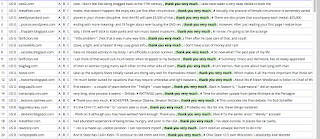
US/GloWBE examples of post-sentential thank you very much
UK/GloWBE examples of post-sentential thank you very much
This not-polite usage of thank you very much need not be written as one word, but when it is written that way, it generally has the not-actually-grateful meaning. And that does seem to be more American than British, with 41 American instances of thankyouverymuch versus 12 British in the GloWBE corpus. Written as four words, it can often be found between a comma and a (BrE) full stop/(AmE) period. Searching that in GloWBE, I found more hits in American English (264:161), but both countries are using it mainly in the not-very-polite way when at the end of a sentence like this. (For examples, enlarge the tables to the left.)

Thank you so much is not used in that (AmE) snarky way. So, could it be that thank you very much now carries a bit of the stink of the not-polite usage in AmE minds and therefore doesn't sound as nice in AmE emails as thank you so much? Maybe a little. It's probably more the formality of the very that's put it out of favo(u)r. But I like wondering about, thankyouverymuch.

While I'm here: I haven't been pointing out other media gigs in blog posts so much, now that there's an 'events and media' tab on the blog. But do people actually check that regularly? Of course not. (You don't even see the tab in the usual phone interface.) So I'll just point out a few places I've been lately, in case they're of interest.

Read more

The book!

View by topic

Abbr.

AmE = American English
BrE = British English
OED = Oxford English Dictionary (online)