transfers and decals

John Wells recently asked me if he was right in thinking "that BrE consistently uses transfer and AmE decal for the same thing". That's the kind of question that is perhaps best answered with a rhetorical question: Is any English vocabulary used consistently?

We're talking about ways of putting images onto other things. In that semantic area, I have both the words transfer and decal in my AmE vocabulary, so I was tempted to say "No, decal means something different from transfer in AmE." But then I thought I should find out if that's just me. It's not just me. But it is complicated. 

 The word decal is definitely more AmE than BrE. 

GloWBE corpus

But what are decals? Some possibilities: 

1.  Images that can be ironed on to fabrics. E.g. on (orig. AmE) t-shirts or (orig. AmE) tote bags.

2.  Images on paper that can be transferred to other things when wet.

  • This was what John was thinking of—he recalled ones from his youth for decorating skin. These days, in both AmE and BrE, those are often called temporary tattoos. But decal in this sense is not limited to the skin ones. They might be images that are put onto, say, model airplanes, as in the top right photo here, from a how-to video.

3.  Images on vinyl (or similar material) that have sticky material on the image side, so that they can be stuck onto glass (or similar) and show through.  The companies I can find that sell them seem to call them reverse-cut vinyl [stickers/transfers/decals].

Image from diginate.com

 4.  Vinyl or other high-quality stickers of any sort, intended for use on glass, vehicles, etc.  I.e. not just the reverse-cut type, but anything of the type you'd stick onto a car window, say. 

  • In this case, we can see a phenomenon called lexical blocking. Bumper stickers should be counted under this definition as decals, but since we have a special term for bumper stickers, i.e. (orig. & mainly AmE) bumper sticker, we don't tend to call them anything else. The vinyl stickers on cars that are called decals are different enough from typical bumper stickers (in size, shape, or placement) that they don't meet the criteria for that term.

In my idiolect, decal can be any one of types 2–4, but not the iron-on type. I would call those iron-ons or iron-on transfers. But when I looked up decal in dictionaries, I found the iron-on type potentially included in some definitions, like this one from Collins COBUILD, which gives transfer as the BrE equivalent.
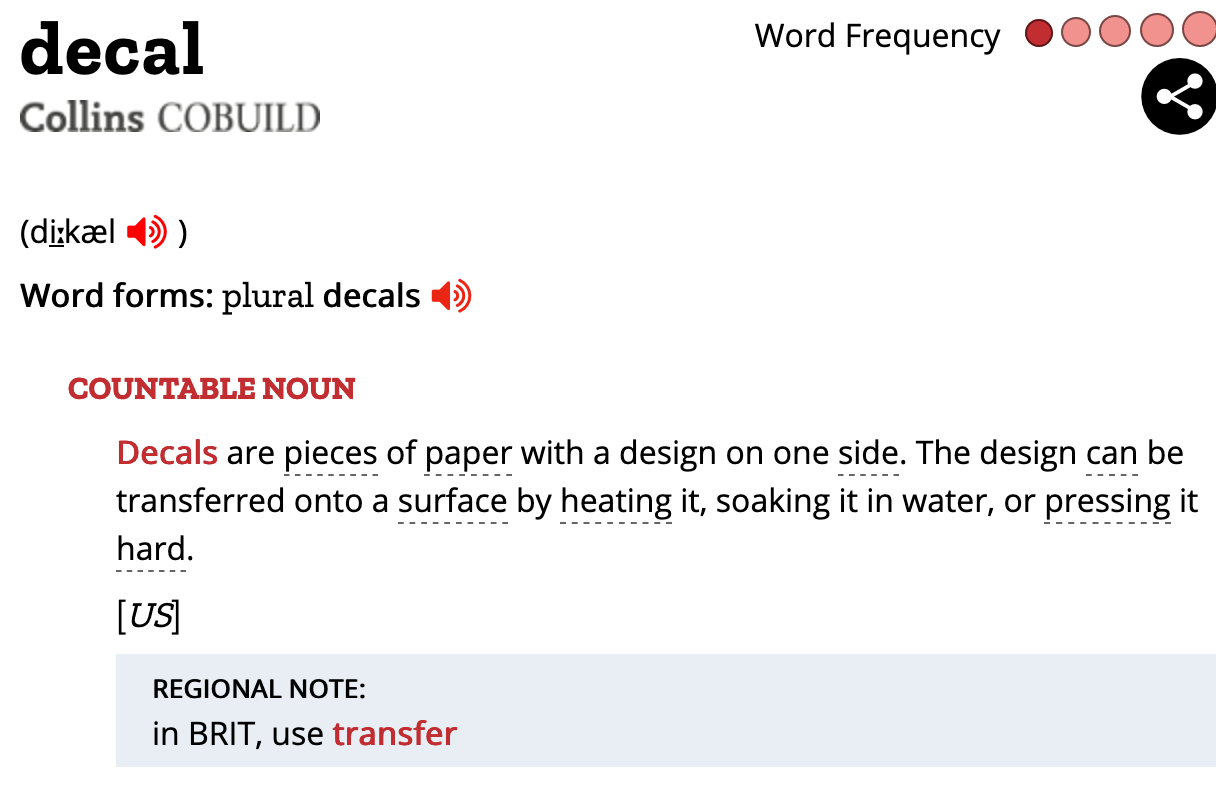

(However, since it says that a decal is a piece of paper, it's not clear that the vinyl type (3-4) would be included. In all except type 2, the design itself isn't paper, so it's perhaps not the greatest definition. The paper on those is a disposable part, not the decal itself.)

Other dictionaries, like Merriam-Webster and Cambridge, limit decal to types of stickers and don't mention heat-transfer, so more like how I use it. 

But then I started asking my American friends—all from my generation, but different parts of the country—what they called the things they might iron onto a t-shirt, and one (she's originally from Kansas, but has more time in Wisconsin/Illinois) immediately offered decal. The others, generally from more eastern parts of the country, said iron-on or iron-on transfer or just transfer

And so I did a Twitter poll. The problem with polls is that you usually only want to hear from some people, but other people will want to do the poll. I don't know if those other poll-takers care that I throw away their data, but I do know that I have to give them the chance to give it to me because otherwise they pretend they're part of the target group and will thereby mess up my numbers. But after a bit of math(s), we can see (a) that Americans are fairly split on whether iron-ons are included under decal and (b) that my iron-on-excluding usage has slightly more users among my Twitter followers. Keep in mind that my followers may skew older (it's Twitter) and eastward (because of time zone issues).

This all provides more fuel for the idea that we shouldn't talk about what "the American" or "the British" term for something is. (Though I'm sure you'll catch me doing that sometimes.) There's a lot of variation in both, so it's better to think of most expressions as representing an American or a British way of saying things. 

Because of the limitations of Twitter polls, I could only ask about one facet of the word's potential meaning: whether or not iron-ons are included. Some followers responded with more specific meanings for decal than I have, for example, one said that he'd only use decal for type 2, in model-making.

For transfer, it's clearly an exaggeration to call it 'British-only' in all of the senses, since Americans do seem to use it for (at least) sense 1. Yet that's what some dictionaries do.

This definition from Lexico has an example that would be at home in AmE:

I am tempted to say that transfers have a reverse-print image that is pressed onto a surface, whether that be skin, fabric, glass, etc. (so uses 1-3 above). But there are enough companies out there selling non-reverse-print "vinyl transfers" that reverse-ness is not at this point a necessary condition for many people's understanding of transfer.

To sum up: 

  • Decal is a fairly American word, but Americans vary in how they define/use it.
  • Transfer as a noun for a type of image printing/attaching occurs in British English, but is also available in AmE, especially for the iron-on type.

PS: there is variation in how decal is pronounced in AmE, particularly which syllable gets the stress. You can hear more on YouGlish. In my experience, it's more common to put the stress on the first syllable. Thanks to Adonis in the comments for raising this.

Read more

agoraphobia

Hello from my dad's house in New York State. Not only did I survive my hotel quarantine, I (more BrE in this position) quite enjoyed it.  In the three days that I've been out, I've done several things that I haven't done since March (at least), including going into a supermarket and a restaurant. What I really missed in small-town American quarantine was the ability to get things delivered (and to order them over the internet, not phone—which would have been an international call for me). I was almost completely dependent (save one Domino's delivery) on brothers and sisters-in-law to shop or get take-out/take-away for me. The very American hotel room had a fridge/freezer and a microwave, so at least I didn't need help every day.

I was extremely well-suited for the quarantine. First, I love staying in hotels. They don't even need to be fancy hotels—just clean and quiet ones. Second, and more importantly, I had four years of cautious and isolated living in South Africa. I got very good at keeping my own company. Third, I have a book to write. The hotel days flew by for me. 

I'd already been thinking, during lockdown in the UK, that I didn't really mind not being able to go out much. Though I usually have a full social calendar of restaurants and shows and quiz nights and parties, I was generally not missing them. (The only thing I'm really-really missing is writing in coffee shops. I find it very hard to book-write at home. Or hotel.) I also have hypochondriac and germophobe tendencies, so the more I stayed (at) home, the more I feared going out. And so I'd been wondering a lot about whether I'd be ready when restrictions lifted and I could go out. And wondering if this is going to be a widespread problem.

This trip to see my dad is functioning as intensive desensiti{s/z}ation therapy, but I'm not the only one who has worried about agoraphobia, as you can find by googling "coronavirus" and "agoraphobia". Here's a bit from one piece in the British newspaper i:

Fletcher says he’s noticed a huge spike in the number of referrals to his client base of individuals displaying agoraphobic tendencies since lockdown began – as have organisations such as Sane and Anxiety UK, both of which reported a 200 per cent increase in calls to their helplines related to the pandemic.

But the thing that stops me from talking about this matter is the pronunciation. When I say agoraphobia, my British friends either don't understand me the first time or comment on my strange pronunciation. I pronounce it with the o, the word agora ('gathering place, marketplace') plus the word phobia. "aGORaphobia"  When my UK friends say it, it's more like "agraphobia", which to me sounds too much like acrophobia—fear of heights.

Neither my friends nor I are pronouncing it in the way that most dictionaries have it, with the o pronounced as an unstressed vowel (schwa). Agheraphobia. 

But, and I don't know if this will work when you click on it, my pronunciation is the one that Google gives as American


Unfortunately, it's also what they give as the British pronunciation. Don't believe everything that the internet tells you. Audio files of pronunciations are potentially a wonderful plus for online lexicography, but they are the most likely part of a dictionary entry to be wrong, as far as I can tell. You can't do lexicography well without a lot of person power, and these files have often been rushed to the web in some kind of automated way. I recommend a lot of caution on British services' American pronunciations and vice versa.

But another bit of evidence that we can use for pronunciation is spelling, and I have seen agoraphobia represented without the first o in BrE, indicating that some people aren't hearing it there (and maybe don't know the etymology from agora). There's not a lot of this in the GloWBE corpus—but there is a little. As well as evidence that people don't talk about it as much in AmE:


In the end, this is not a very common word, and many people will have experienced it either in print or in speech but not both, allowing for a lot of variation in how people assume it should be pronounced or spel{led/t}. I'd expect that a lot of you will have different experiences of what you think the most common pronunciation where you are is. You can hear a lot of them at YouGlish (be sure to click the 'forward' button to advance to the next pronouncer) and draw your own conclusions.
Read more

isolation/lockdown/quarantine

Recently I was asked to write a piece for an organi{s/z}ation about whether publications should be in "Global English". You'd think "Global English" would be relevant during a global pandemic. But the pandemic has illustrated that variation is the natural state of English around the globe. So far, I've looked into what people call the disease and the advice to 'stay (at) home'. Today's topic is what we're doing at home. 

Osman Faruqi posted this on Twitter, and Superlinguo Lawren Gawne copied me in:

Lucky for us, there's the Coronavirus Corpus, a wonderfully timely resource from Mark Davies and team at Brigham Young University, who are responsible for most of the corpora I cite on this blog. 

The Coronavirus Corpus is designed to be the definitive record of the social, cultural, and economic impact of the coronavirus (COVID-19) in 2020 and beyond. 

Unlike resources like Google Trends (which just show what people are searching for), the corpus shows what people are actually saying in online newspapers and magazines in 20 different English-speaking countries.  
The corpus (which was first released in May 2020) is currently about 510 million words in size, and it continues to grow by 3-4 million words each day.

 And thanks to that corpus, we can see that Faruqi's intuitions are (orig. BrE) spot-on.


AusE during iso (which follows a general trend for clipping in informal Australian English) might be common in speech, but since the sources here are news-related, they have only a handful of during iso and about 80 times more during isolation.

It's worth noting here that the island nations don't follow their neighbo(u)rs. New Zealand has lockdown like British — though of course NZ's way of dealing with the pandemic has been very different from the UK way. Ireland looks more like Australia than like GB. (I'm never sure whether Davies' corpora are including Northern Ireland with Ireland. The use of Great Britain rather than United Kingdom indicates that they might, but since some Northern Irish websites are going to end with .uk and not .ie, I don't know how much trust one can put in that. I really should find out about it...)

Now, these expressions are not literally accurate. They're all talking about situations where people are advised to stay at home and some range of public places are required to stay closed. If you live with friends or family in Australia, you're not really 'in isolation', right? I've seen people in the UK saying that we shouldn't call it lockdown because that'll make people feel like they're being imprisoned and punished (and therefore more likely to feel justified in 'escaping'). I've seen Americans complain about this use of quarantine because most Americans are not literally quarantined. (Unlike me. I am writing this in the middle of my 14-day quarantine* after travel to the US. I am staying in a hotel room, dependent on groceries dropped off by my brother, waiting to be 'clear' to visit my dad. I am happily re-connecting with my hermit tendencies and may require careful reintroduction to society when this is over.) 

*Don't tell me that quarantine is literally 40 days. That's its etymology, not its meaning in current English.

But I'd argue that you don't have to worry about the accuracy of these phrases because (a) words can (and usually do) have more than one meaning/usage, and (b) I'd say we're using them more like proper nouns. While we don't spell them with initial capitals, notice how we are treating these words as the name of a particular time period, like Ramadan or October or (AmE) spring break or (BrE) half term. Proper names don't have to describe, as we know from names like Greenland. It's not an accurate descriptor of that place, but we know which place you're talking about if you say Greenland. Quarantine/lockdown/isolation is a particular time period associated with particular activities, just like Christmas(time) describes a particular time period with particular activities.

I'm often asked about my "Difference of the Day", which I've been doing every weekday on Twitter since mid-2009, and the question is always "Haven't you run out yet?" Not by (orig. AmE) a long shot/(BrE) a long way. And I'm never going to run out because we keep finding new ways to differ.


News

  • I've skipped a few weeks of blogging because of other writing gigs. One of them was to write a blog post for the Speaking Citizens project, which is researching (BrE) oracy education in the UK. My angle on it was to think about the differences in education cultures in the US and UK (related to my thoughts in chapter 8 of The Prodigal Tongue). If you're interested, you can read it here.

  • My big news is that I have been hono(u)red with a Public Scholars grant from the National Endowment for the Humanities. It was a Public Scholars grant that allowed me time off from my day job to write The Prodigal Tongue. I'll have six months off from my university job to continue to work on my current project, which has the working title Small Words. Here's the synopsis:
  • Books about words often concentrate on the dialectal gems, the lost lexicons, the rare and peculiar species of the linguistic world. By contrast our most common words are given scant attention, mumbled in speech and glossed over in reading. We notice the weighty nouns, verbs and adjectives, but miss the slippery mortar holding them together: 'be', 'the', 'not', 'if', 'and', ‘of’, ‘it’. But poke those small words, and each opens up a world of discovery into human minds and cultures. Take ‘the’, as just one example. How can it be the most frequent word in written English, when many of the world’s languages have no need of an equivalent? Why does it cause trouble for Bible translators? Why does it feel different when an American speaks of ‘the Mexicans’ rather than ‘Mexicans’? Why do English writers use it less each year? This book synthesizes research from across the humanities and social sciences, allowing the small words to tell us stories about what it is to speak English and what it is to be human.
  • You'll probably see me blogging more about the little words in the coming months (or just blogging less). Of course, I've already blogged a lot about prepositions, conjunctions, determiners, and interjections here, so it's stuff I've been thinking about for a long time.

Read more

The book!

View by topic

Abbr.

AmE = American English
BrE = British English
OED = Oxford English Dictionary (online)