The US-to-UK one may be as controversial as it was the first time(a)round (in May). But here goes:
2022's US-to-UK Word of the Year is: homer
Why?
Because it is possibly the most talked-about Americanism in British social media this year.
Because if I chose the other finalist,* I'd get too many "that's not a word!" complaints.
Because it alludes a huge, wordy phenomenon of 2022.
That phenomenon is Wordle, the word game invented by a Welsh engineer in the US, an added transatlantic bonus.
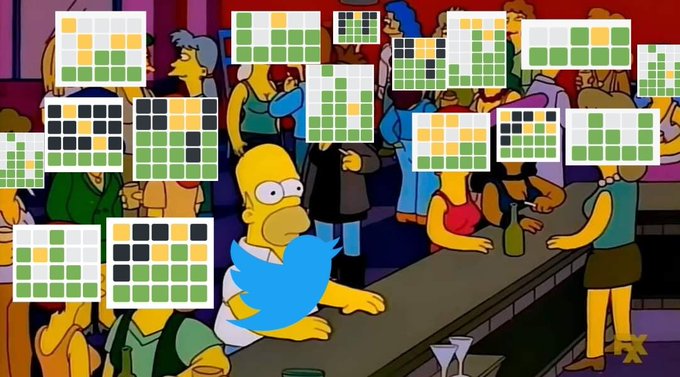
Homerwas the Wordle solution on the 5th of May, setting off a lot of grumpiness on social media. The cartoonist Stephen Collins provides a good illustration of the depth of feeling on the matter on the part of many committed UK Wordlers:
So, this isn't a Word of the Year because British people have taken on the word to refer to baseball home runs. There is very little need to talk about baseball in Britain. It's US-to-UK Word of the Year because it was an Americanism talking point in Britain, demonstrating how separate our vocabularies can be.
But is it an Americanism? The thing is, British people do say homer for lots of other reasons. In various BrE dialects or jargons, it can be a homing pigeon, a (BrE) match played on the home (BrE) pitch in some sports, or "a job that a skilled worker, such as a house painter or a hairdresser[..], does for a private customer in the customer's home, especially when they do this in addition to their main job and without telling their employer or the tax authorities" (Cambridge Dictionary). It's also the name of an ancient Hebrew measurement. But none of these uses are as common in BrE as homer meaning 'home run' is in AmE, and so the word was definitely perceived as an Americanism by British Wordle players.
Now, this choice isn't exactly original on my part. Cambridge Dictionary made homer their Word of the Year back in November. It's also been noted as one of the most Googled words of the year. But that's another reason why it feels right as the US-to-UK Word of the Year. It not only spiked high in their look-up statistics on the day, it continued to be looked up in their online dictionary for months after—perhaps because BrE speakers just can't stop talking/tweeting about it. Homerwas again showing up in tweets about losing one's Wordle streak on 27 December, when the answer was the tricky HAVOC. (And I imagine it was showing up in the less searchable social media as well.) It'll be interesting to see if it's still being put to these purposes next year, or if it'll have been forgotten. The chances that it'll be forgiven seem thin.
I do encourage you to have a look at Cambridge's Word of the Year site for more on this word, British–American linguistic relations and how Wordle's been affecting dictionary usage.
*My other "finalist" was them's the breaks, as spoken by Boris Johnson in his resignation speech outside 10 Downing Street. I was sure in July that that would be my "Word" of the Year, but, two Prime Ministers later, this well and truly feels like ancient news now.
Having let the year run its course, I'm now am ready to declare the Separated by a Common Language Words of the Year for 2022. As ever, there are two categories: US-to-UK and UK-to-US. To be a SbaCL WoTY, the word just needs to have been noticeable in some way that year in the other country.
Now, of course the word fit is general English when we use it in contexts like The shoes fit or I'm going to get fit this year. But those fits are not my UK-to-US Word of the Year. The fitI'm talking about is the informal British usage that means 'attractive, sexy'. A close (orig.) AmE synonym is hot.
Ben Yagoda, on his Not One-Off Britishisms blog, first noticed this sense of fitin an American context back in 2013, but it seems to have taken hold in the US in the past couple of years. I assume this is due to the international popularity of the British television (BrE) programme/(AmE) showLove Island.
Here's a clear example of this sense of fit from another UK reality series, Made in Chelsea.*
I like that video just because it's clearly fit meaning 'hot' rather than 'healthy and/or muscular', but if you'd like to hear it said on Love Island, then you can hear it here at 1:38 (though the YouTube automatic subtitling mishears it as fair).
This use of the word is new enough to the US that it's included in glossaries for American Love Island fans, like this one and this one. The Oxford English Dictionary added it in 2001:
Britishslang. Sexually attractive, good-looking.
1985 Observer 28 Apr. 45/1 ‘Better 'en that bird you blagged last night.’ ‘F—— off! She was fit.’
1993 V. HeadleyExcess iv. 21 ‘So wait; dat fit brown girl who live by de church ah nuh your t'ing?!’ he asked eyebrows raised.
1999 FHM June (Best of Bar Room Jokes & True Stories Suppl.) 21/1 My first night there, I got arseholed, hit the jackpot and retired with my fit flatmate to her room.
2000 Gloucester Citizen (Nexis) 14 Feb. 11 I would choose Gillian Anderson from the X-Files, because she's dead fit.
Green's Dictionary of Slang has one 19th-century example, but notes that "(later 20C+ use is chiefly UK black)."
I can't give statistics on how often this fit is use in the US because (a) the word has many other common meanings, making it very difficult to search for in corpora, and (b) this particular meaning is not likely to make it into print all that often. (Slang is like that.) Ben Yagoda considers fit"still an outlier" in AmE. But Ben's probably not in the right demographic for hearing it.
An anonymous blog reader nominated it, and it struck me as apt for 2022—the popularity of "Love Island UK" (as it's called in the US) was hard to miss on my visit to the US this summer. I got to hear my brother (whose [AmE] college-student daughter loves the show) imitating the contestants, throwing in words like fit. I can easily find young US people using and discussing 'sexy' fit on social media (though I won't share their examples here because those young people didn't ask for the attention). And it made it onto Saturday Night Live, in a sketch about Love Island. You can hear proper fitat 1:11:
So Happy New Year to you! I wrote this post after watching the fireworks (on tv) at midnight. Now I'm (BrE humorous) off to Bedfordshire, so I'll leave the other WotY for tomorrow. Stay tuned for the US-to-UK WotY!
*Update: I'm told that the Made in Chelsea video does not play in the US. Here's a quick transcript of the relevant bit:
Scene: Two male cast members on a sofa, commenting on this video shot of a female cast member:
If you'd like to subscribe to the newsletter, follow this link. You'll get around one newsletter per month. The newsletters have something about British–American linguistic relations (often linking to blog posts here), a bit about what I've been up to in my Lynneguist life (as well as things in the works), and links to things I've found interesting.