in (one's) stride, at (a) pace

This post is inspired by a poll that Ellen Jovin, aka the Grammar Table, ran in September. Before I get into that, let me point out that there is a Kickstarter to support the documentary about her spreading grammatical joy across all 50 US states. It'd be lovely to be able to see that film in a (BrE) cinema/(AmE) theater or event near you, near me and near everybody. So if you have the wherewithal to support it, click!
https://www.kickstarter.com/projects/rebelwithaclause/rebel-with-a-clause
 
Now back to our (somewhat) regularly scheduled grammar-gazing. 

to take (something) in (one's) stride

Ellen asked on social media whether people say take it in stride or take it in one's stride


When I see a split like that, I think dialects.

The version with a possessive pronoun, to take in one's stride, is the more British (and non-North American) version:


And the shorter version, to take in stride, is the North American: 


The phrase is a metaphor from horse racing. As the OED defines it:

to take in one's stride: of a horse or its rider, to clear (an obstacle) without checking one's gallop; figurative to deal with (a matter) incidentally, without interrupting one's course of action, argument, etc. Also (chiefly U.S.) without possessive adjective.

It seems to come from the UK in the early-mid 1800s, and then takes off in its possessiveless form in 1930s US. (The possessive-ful lines are low in the following graph because I had to choose just one possessive form to search—I chose his for the illustration because it's the most frequent in this phrase in Google Books.)


It's not clear to me whether AmE speakers back then were familiar with the racing expression. If not, then the expression might not have been recogni{s/z}ed as metaphorical, and therefore might be more likely to change.

But then again, I'm not sure the possessive is absolutely needed—you wouldn't take something in someone else's stride. So maybe Americans dropped the possessive in both literal and metaphorical usage. A horsey person might have to tell us.

at (a) pace

At pace (meaning 'moving fast') is a similar expression—a prepositional phrase involving a noun that alludes to walking—and it has no possessive or other word introducing it. But that doesn't help us explain the American loss of the possessive in in stride, since at pace is a more British and much more recent expression. 


An older version has the indefinite determiner: at a pace. That's found in similar numbers in AmE and BrE. And then there's the very old (Middle English) expression apace, which means much the same thing and sounds much like at pace. It's possible that at pace is an eggcorn for apace, or that it's at a pace without the a, or maybe it's a bit of both—i.e. different people have come to the same form from different angles.

why?

So we have two phrases that originally had a determiner* (a possessive pronoun or an article) between a preposition and a noun for a stepping action, and in just one place (but not the same place) the expression has been getting shorter. Why? Well, the basic answer is: language changes and it doesn't ask anyone's permission. If it changes in one place it doesn't need to change in the other. And for set phrases like this, change is likely to be piecemeal. Just because one phrase loses its determiner, doesn't mean all such phrases will. 

Since these expressions have got(ten) more and more figurative over the ages (referring to properties like ease and speed, rather than literal steps or paths), the determiners have had less and less work to do. Since they are unstressed syllables, they're easy to swallow up. So, if they go, we might not miss them, and if they stay they probably won't bother us. C'est la parole


*You'll see above that OED calls these things possessive adjectives. I don't. They act more like determiners (e.g., a(n)the and this) than like adjectives like good or corporate.
Read more

one-off and one-of-a-kind

Congratulations to Ben Yagoda on his new book Gobsmacked: The British Invasion of American English! If you like this blog, you are going to like that book. I was both gobsmacked and chuffed to see that I was among the dedicatees of the book (and in wonderful company). It even has an appendix of my UK-to-US Words of the Year! (And on that note—feel free to start nominating 2024's Transatlantic Words of the Year.)


Ben has been observing the transit of British English words, pronunciations and grammar for 13 years now at his blog Not One-Off Britishisms. So, to celebrate his book, let's look at one-off, the Britishism in his blog title.  One-off can be used as a noun or an adjective to refer to something happens once and won't happen again.

Ben's blog evaluates previously British-only expressions that seem to be catching on in American English, and one-off was one he first covered in 2011. In the book, he gives more historical context for both the British and American usage. Google Books charts (nicely redrawn by Eric Hansen in the book) provide a handy view of the trajectory of British words in American publications over time.

In the case of one-off, the first known occurrence of it is in 1930s Britain. It seems to take off in Britain in the 1960s, then shows up in the US in the 1990s, picking up speed as it goes along.  Here's the the relevant bit of the book:

Graph showing one-off usage in US lagging behind that in UK.

 
He also categori{s/z}es each expression as to how entrenched it has become in AmE. In the case of one-off, it's "taking hold."  

While Yagoda keeps track of the migration of Britishisms, my (self-appointed) job on this blog is to give American English translations. One-of-a-kind seems a good candidate But is one-of-a-kind American English or General English? And is one-off displacing it at all?

My first stop is the Corpus of Global Web-Based English, whose data comes from 2012:
 

Now, we don't always hyphenate one of a kind (it depends on how it's being used in a sentence), but this chart at least gives a sense that one-of-a-kind is used proportionally less in BrE, since it has one-off to use instead. In the same corpus, unhyphenated one of a kind is still "more North American," but more gently so: 490 US hits to 320 GB ones. 

All of the Oxford English Dictionary quotations for one-of-a-kind are North American too—the first one from 1954 by American art critic Arthur C. Danto. (The first unhyphenated one is from 1977.) The OED does not, however, mark it as an American expression. 

Now, one-off and one-of-a-kind aren't exactly the same thing. One-off has a more temporal connotation: it's happened once (and won't again). That said, you could say, for example, that a person is a one-off or one of a kind meaning that they're a unique kind of person.

So is the existence of one-off hurting one-of-a-kind? It happens to be easier to look at the unhyphenated version in Google Ngrams and the hyphenated one in the Corpus of Historical American English, so let's look at both.

First, we can see that one of a kind has been increasing fairly steadily in both AmE and BrE, but it's definitely more American. One-off's appearance on the American scene has not caused one of a kind to become less frequent. 

And here's the hyphenated one-of-a-kind in comparison with one-off in American English since the 1940s. American use of one-off has taken off in the 21st century. One-of-a-kind is still used more, but the gap is closing:


How are both of these expressions doing so well?  Well, it seems to be because everything in the world has got(ten) more unique. Here's the Google Ngram for unique, going up-up-up in English generally since World War II. 


And just for the pedants, here's the chart for more unique:


(I wonder what proportion of the hits for more unique are just people complaining or warning against more unique.)

Anyhow, congratulations to Ben Yagoda on the success of his blog and the publication of his book! 
And so many thanks for this kind dedication:


Read more

crochet, boondoggle, scoubidou

Before the school year started, the 16-year-old and I (BrE) had a day out at a "Learn to Crochet" course. Here's my first. slightly (BrE) wonky (orig AmE) granny square (which, according to this site were once called American crochet in Europe):


a dark pink granny square on a wooden background


The instructor started by warning to always ascertain the provenance of a crochet pattern before embarking on it because the US and UK terminology differ in potentially disastrous ways. In the take-home materials, we were given two charts. One spells out the differences in names of stitches. What's called single crochet in AmE is double crochet in BrE—with (orig. BrE) knock-on effects for other stitches. So, AmE double is BrE treble, AmE half-double is BrE half-treble, and AmE triple treble is BrE double treble


Crochet abbreviations conversion table: see paragraph above for the relevant difference

Now the obvious question is: how can you get to double without having single first?  The answer (according to KnitPro) is that the BrE is describing the number of loops on one's hook during the stitch, and the AmE is describing the number of "yarnovers when pulling up your first loop". Yarn over (the site uses it as one word and two) is another difference according to that site: in BrE it's called yarn over hook. Yarnover is essentially how many actions you're doing to complete the stitch. That KnitPro page has more description. 

Let's just pause here and note that crochet is pronounced differently in the two countries because of the general rule that for two-syllable French borrowings, BrE stresses the first syllable and AmE the second one.  And then there's what happens when AI gets its hand on the pronunciation:


Lynneguist on bluesky: The main thing I've learned from watching crochet reels is that the automatic voiceover pronounces 'crocheter' as 'crotch-eater'. If you close your eyes and listen to the narration, it takes on a rather different tone.


But back to the charts the instructor gave us. Just as there are differences in measurements for cooking, the measurements for crochet hooks are different in US and UK because of the "Americans haven't gone metric" problem. The US uses letter or number sizes, whereas the rest of the world uses more transparent millimeter measures. So, US size B = US size 1 = 2.25mm. From the chart below, it looks like no one knows what size N or P are.


This alt text is copied from the Craft Yarn Council site and may be a bit different from the picture of the chart from my crochet class:  2.25 mm	B-1  2.75 mm	C-2 3.125 mm	D 3.25 mm	D-3 3.50 mm	E-4 3.75 mm	F-5 4 mm	G-6 4.25 mm	G 4.50 mm	7 5 mm	H-8 5.25 mm	I 5.50 mm	I-9 5.75 mm	J 6 mm	J-10 6.50 mm	K-10 ½  8 mm	L-11 9 mm	M/N-13 10 mm	N/P-15 11.50 mm	P-16  15 mm	P/Q


While knitting stitches generally have the same names in US and UK, knitters have the same problem for knitting needle sizes.  You can find more info about these sizes and other conversion problems at the Craft Yarn Council website.  (In my experience, new crochet hooks are likely to have both kinds of size printed on them, and online retailers will indicate both. But if you're using older hooks, you will probably need a chart like this.)


Now, this class wasn't really my first crocheting—I'd done straight lines and zigzag crocheting as a child. Also big in my Girl-Scouting (UK Girl-Guiding) childhood was (AmE) boondoggle. Nowadays, this is an American word that can mean 'a wasteful or useless product or activity', often in reference to (more AmE) government/(more BrE) public spending. Originally, it meant 'a trivial thing', from which came to be used for a kind of twisted leather object that Boy Scouts used for fixing their kerchiefs (click link for picture). It then extended to the weaving of flat plastic cords that was a popular craft back when I was a kid.

Screenshot of a google result for a Reddit page titled "You guys remember Boondoggle?! Anyone know any other cool stitches?" with three pictures of maybe 6-inch lengths of boondoggle/scoubidou in different colors

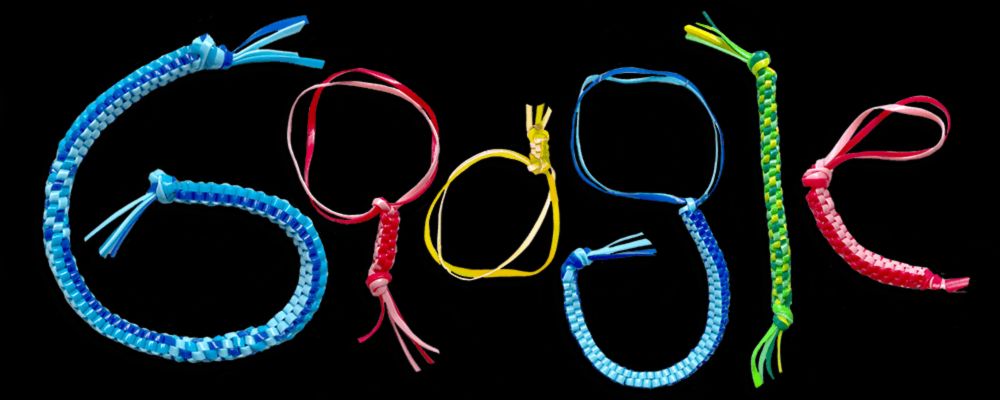
And I thought of that this week when the Google Doodle in the UK was in hono(u)r of this craft (which has apparently had a revival), except it had the BrE name for it, borrowed from French: scoubidou. 

Version of the google logo presented in boondoggle/scoubidou braids.

The Google Doodle was about "Celebrating Scoubidous". On first reading, scoubidous looked like an adjective to me (SCOUb'dous, that which is scoubi?). Part of the reason I read it wrong the first time (even though I knew the word scoubidou) is that I wasn't expecting it to be plurali{s/z}ed.  I use boondoggle as a mass noun, so for me the things in the photos are pieces of boondoggle (or something like that), rather than as boondoggles. I'm not sure if that's just me, and there's too much 'government spending' noise in the data for me to quickly check it. (Happy to hear from other former Girl Scouts on the matter.) 

Is scoubidou related to Scooby Doo? Not directly, I think. There was a song Scoubidou in the 1950s, and I suspect that the craft and the cartoon dog were separately named after it. But the dog's name was for some time spelled/spelt Scoubidou in France.
Read more

The book!

View by topic

Abbr.

AmE = American English
BrE = British English
OED = Oxford English Dictionary (online)