Showing posts sorted by date for query canadian. Sort by relevance Show all posts

Are these words misspelled/misspelt most?

The people at WordUnscrambler.pro sent me a list of "the most misspelled (BrE misspelt*) words" for the UK. I get a lot of these "we did this thing so that your blog will give us free advertising," and I usually ignore them, but I'll give this one some attention—partly because they sent a US list to Language Log (who published it), so I can do some comparison. 

But I first have to gripe a bit. Here's the methodology:

            We analyzed Jan 1, 2025 - Dec 17, 2025 search data from Google Trends for "How do you spell" and "How to spell".

That's not a method for discovering the "most misspelled words." That's a method for discovering the most looked-up spellings. This is the kind of (BrE) jiggery-pokery makes me hate headlines.  If you think to look up a word, then you might be insecure or curious about its spelling. But that's keeping you from misspelling it. I'm betting that when they're not looking up spellings like these, those people are out in the world (like the rest of us) are confidently spelling accommodation with one m and letting spellcheck catch it for them (or not).

Nevertheless, the WU.pro folks showed admirable linguistic sensitivity in not declaring the Americanisms on the list "misspelled." Instead, they note repeatedly that both the US and UK variants "are correct". 

United Kingdom's most misspelled words queried spellings:

1.     Colour - 109 200 searches - Both colour and color are correct.

2.     Favourite - 82 900 searches - Both favourite and favorite are correct.

3.     License - 59 000 searches.

4.     Diarrhoea - 58 700 searches - Both diarrhoea and diarrhea are correct.

5.     Jewellery - 56 400 searches.

6.     Definitely - 53 000 searches.

7.     Auntie - 50 400 searches - Both auntie and aunty are correct.

8.     Weird - 48 000 searches.

9.     Business - 46 800 searches.

10.   Behaviour - 40 800 searches - Both behaviour and behavior are correct.

11.   Neighbour - 39 600 searches - Both neighbour and neighbor are correct.

12.   Country - 29 000 searches.

13.   Queue - 22 800 searches.

14.   Gorgeous - 22 600 searches.

15.   Necessary -  23 000 searches.

I've added the blue to show which ones are also on the US top 10, which I've copied at the bottom of this post.† (Not sure why the UK got a top 15 and the US a top 10. Nor why necessary has more searches but is lower on the list than queue.) 

Some of these are definitely difficult—others, like country, surprised me. But let's have a little look at whether people do misspell them, using the Corpus of Global Web-Based English. (I'm using that one even though it's 13 years old now because web-based English is more likely to include misspellings than the published writing in other comparative corpora.) I won't try to cover all of them, just the ones that strike me as transatlantically interesting.

Postscript : On the same day as I wrote this post, another company released its (much better) analysis of British misspellings. See the bottom of this post for more on that. 

US/UK variants

Where there are US/UK variants, it's often the case that the corpus has included American writing and tagged it as GB because it's on a British website (or vice versa). For that reason, I've (in another post) used -or/our spellings as a diagnostic for how reliable the country tagging is in GloWbE. So, it's not necessarily the case that BrE writers are mispelling them. 

-or/-our 

In that vein, the following graph shows that there's probably more AmE writing on UK websites than BrE writing on AmE websites—which is not so surprising, since there are presumably about 5 times more US than UK writers on the internet and text from American wire services and other companies might be reprinted wholesale on UK sites.

variant spellings for favourite, color, and neighbor show the O-R spellings strongly American, but they also account for about 1/5 of the British-tagged spellings
rates of -our versus -or spellings in GloWbE


But the other thing to take from the our/or chart is: Canadian spelling is in crisis. The (standard Canadian) -our spellings only just outnumber the -or ones. Meanwhile, the Canadian Prime Minister recently got into trouble for using British -ise spellings that are not traditionally Canadian. 
 

licence/license

License is a tricky one because it's the correct spelling for BrE, when it is a verb. But it is licence in BrE when it is a noun (in AmE for both).  The first chart here shows a lot of (incorrect for BrE) license as a noun in the GB corpus—but that will, again, be partly due to American writing on British websites, rather than British writers misspelling it. It's hard to know how much each factor contributes.

in the word string 'a license to', there are 275 spellings with s on UK sites, and 450 with the "correct" c

So, more interesting from a misspelling standpoint is licenced, which is incorrect in all Englishes, but about 5% of the UK spellings. License is definitely a word that Britons misspell.

I was surprised not to see practice/practise on the UK misspelling list. You can read more about that at an older post, if you'd like to.


Diarrhea/diarrhoea

This one seems to have little to do with US/UK confusion. Diarrh(o)ea is just difficult and unpleasant for everyone. And personal: everybody's misspelling it their own ways:

(The crossed-out ones are names that happened to be caught on my search for "diarr*a". I don't envy them their diarr-a names.)

jewellery/jewelry

Jewellery is not marked with "jewelry is also correct" in WU.pro's list, but jewelry is the correct spelling in AmE. The AmE/BrE spelling difference is surely adding to the confusion about how to spell it, but the word is just difficult in its own right, with that double L and three-syllable pronunciation (=jewelry). Here's a shortened list of spellings in GloWbE (there are lots more one-off spellings), where the older, now-AmE spelling jewelry appears more than 1/3 of the time on the UK sites, but some definite misspellings make their way in too. 

common misspellings include jewel + e r y , jewel + l ry, and jewel + l a r y

The later jewellery spelling seems to have derived from jeweller + y ('the stuff that the jeweller makes'—analogous to pottery) while jewelry derives from jewel+ry ('products created from jewels'—analogous to pastry, balladry). In 1901, the OED commented (about BrE usage): 

     In commercial use commonly spelt jewellery; the form jewelry is more rhetorical and poetic, and unassociated with the jeweller. But the pronunciation with three syllables is usual even with the former spelling.

So, we might consider jewelry to be AmE and old-fashioned BrE.


Words that are just hard to spell

Weird

It's been my perception that weird is more a problem in UK spelling, and GloWbE bears that out a little bit, with wierd a greater proportion of the UK forms (about 3%) than the US (about 2%):


country

Most people don't seem to have a problem with spelling country, but those who misspell it are not more likely to be British:

queue

The word is much more common in BrE, but hard to spell everywhere. And yet, people seem to mostly get it right. Leaving off the final e sometimes happens, but really not much:


Four queue without final E in British corpus, compared to over 5000 spelt correctly. Around 1600 queue in US corpus, and none of the e-less misspellings.

I'd expected to find the word spelled like its homonyms cue and Q, but there aren't many such misspellings. For the following chart, I searched for queue, queu, que, Q and cue, but none of the queu spellings showed up in the 'in a' phrasing:


The Q spelling might be an abbreviation, rather than a misspelling. But it's striking that the cue homonym is absent from the British entirely. These people know a queue's a queue.


I'm going to leave it there! But feel free to comment on these or the other words on the lists. 


Footnotes

* The fact that misspelled/misspelt has two spellings complicates the old joke: Which word is always misspelled? Misspelled!   (Or is it misspelt?)  Anyway, I have an old post on -ed versus -t past tenses

† The American list, via Language Log:
America's most misspelled words:

  1. Definitely – 33 500 searches.
  2. Separate – 30 000 searches.
  3. Necessary – 29 000 searches.
  4. Believe – 28 500 searches.
  5. Through – 28 000 searches.
  6. Gorgeous –  27 000 searches.
  7. Neighbor – 25 500 searches.
  8. Business – 24 200 searches.
  9. Favorite – 23 000 searches.
  10. Restaurant – 22 500 searches.
------------------------------------------------------

Postscript (28 Feb): Another study!

Another company's marketing ploy, but a much better analysis of misspelling (though only for children):

    Around 530 million spelling attempts from 936,926 pupils across the country were examined by education platform EdShed to draw their results, determining which words schoolchildren find most tricky. (The Independent)

Their list has only two overlaps with the WordUnscrambler one:

  1. Sketch
  2. Mischievous
  3. February
  4. Couldn't
  5. Mustn't
  6. License
  7. Definitely
  8. Indefinite
  9. Convenience
  10. Preferred


Read more

off of, redux

I’ve written about off of on this blog before, in reaction to British complaints about it as a horrid Americanism. In my day job, I’m writing about it again from different angles, so I was thrilled to see that some researchers in Helsinki and Stockholm have undertaken much more wide-ranging and in-depth research about it than has ever been attempted: 
 
Vartiainen, Turo, and Mikko Höglund. 2020. How to make new use of existing resources: tracing the history of geographical variation of off of. American Speech 95: 408–40. 
 
Their paper, as the title hints at, is very much about getting around the problems of studying the history of and variation within the English language, given the impoverished nature of the data we have. There’s lots of English out there, but it’s not always easy to get a balanced view of it. For example, it’s not enough to know where a work was published, you need to know where its author was from. For another example, if all the evidence you have from Sussex is from farmers and all that you have from Yorkshire is from school teachers, then your regionality conclusions are going to be tarnished by other contrasts. Sometimes data sets give this info. More often you either have to go hunting for it and/or the information doesn't exist.

Vartiainen and Höglund have come to their conclusions by triangulating evidence from a number of corpora, each with their own limitations, but together rather convincing. At one chronological end, they’re using the Early English Books Online (EEBO, 1470s–1690s) corpus and, at the other end, a corpus that is updated daily in the present, News on the Web (from which they only use regional UK news sources). They’ve also included a range of sources for American English.  
 
Off of only really takes off in the 17th century. (I won’t go into why that’s so interesting because I have to save things for my book!) In the 19th century, prescriptivists start saying how horrible it is. British prescriptivists have been more damning of it (“vulgarly superfluous”, “a Cockneyism and incorrect”), but American style guides advise against it too (“much inferior to off without the preposition”). The authors suggest that prescriptive attitudes have colo(u)red linguistic description of the term, and there’s pretty clear evidence of this, I’d say, in a lot of the British writing about it, where off of is presented as something from America. Huddleston and Pullum’s (generally excellent) Cambridge Grammar of the English Language claims off of is only used in AmE. Vartiainen and Höglund show that this just isn’t true, and moreover it never was.  
 
Off of originates in England and has consistently been used there. What’s striking is how regional it’s stayed. Here are their maps of where it was most used before 1700 and in the 21st century. It is very much a southern thing.


This gives a big clue about the presence of off of in AmE: 
Importantly, much of the EEBO data predates the Great Puritan Migration to America that took place between 1620 and 1640 (…). Considering that many of the early colonies were founded by people from East Anglia (…), it is likely that they took this form with them. (p. 428) 
They go on to cite examples of off of in the Salem Witchcraft Trials: 
Since then, off of use declined in the US until the 1970s, when it started to go up—possibly as a result of a general tendency toward(s) colloquiali{s/z}ation in written English. It remains mostly a spoken form but has been on the increase in edited text like magazines and newspapers (though not in academic texts). 
…the older generations may have noticed the increased frequency of off of in public texts (a recency effect), while the younger generations may be sensitive to the form’s high frequency in American English when compared to the other varieties of English. (p. 428) 
While it’s certainly possible that the off of surge in AmE could affect current BrE, the evidence from the British data is that it has always been used there. If AmE is having an effect, perhaps it’s just providing a kind of linguistic mirror that makes the form feel less non-standard to those who are already hearing and/or using it in their regional Englishes. The authors conclude that: 
…when it comes to regional variation, we have seen that off of is frequently attested in so many parts of England that the whole idea of its being a “regional form” should be questioned. Indeed, based on the results of this study it would seem that in many cases the perceptions that British speakers have of their avoidance of off of [as a regional and/or American form] are due to highly entrenched prescriptive attitudes instead of their actual usage patterns, although we have no doubt that the form is rare enough in some regions, particularly in the West and Northwest of England, to genuinely affect acceptability judgments. (pp. 434–5) 
There remain problems in making direct comparisons of English from different times and places. For example, the AmE corpora include no casual conversation, but the BrE data do. The authors therefore have to be cautious in comparing rates of usage in the two countries, There is some indication that off of is far more widespread in AmE than in other Englishes. In the GloWBE corpus of web-based English (written, but often not as formal as published English), AmE has 26.2 off of per million words versus 21.5 in Canadian English and 8.7 in British. (That data set has not seen the same care as their main data sets, though. It may contain false hits,  probably contains duplications and can’t give a regional picture.) 
 
The paper includes research on the variants offen and offa. I won’t cover them here, but just mention them to say: oh it’s all so complex and transatlantic. 
 
In all, a fascinating read for someone who’s always thinking about function words and transatlantic linguistic comparisons. (That’s me!) I thank the authors for it and American Speech for publishing it. 
 

Related reading 
If you're interested in out of, it's covered at the original off of post
. You're welcome to leave comments there and keep that conversation going.

Read more

roast(ed)

 I have a note above my desk that says "Next blog post: roast(ed)". It's been there for three years, since Melissa L wrote to say:

Dear Lynne,

I teach English in Germany and enjoy your blog.

I am a native speaker of American English. Most of my teaching material uses British English. I spend a lot of time thinking about and paying attention to the differences between AmE and BrE (though maybe not as much as you).

Anyway, in an exercise about dishes on the holiday table, there was roast turkey and roast potatoes.

I would say roasted potatoes.

 
Roasted is an adjective made out of the participial form of a verb. We make such modifiers all the time—as we say in linguistics, it's a productive morphological process. You could have a written resignation letter, a fried dumpling, a worn path. So, roasted vegetables or roasted turkey don't need much explanation: we're just using the tools that English gives us.

The question more is: what's going on with roast? Is roast beef a compound noun? It's a roast and it's beef. No, that also seems to be a past-participle of the verb, one that goes back to Middle English. These days, it seems only to be used as an adjective. People generally don't things like "I have roast a turkey" or "A turkey has been roast" these days.
 
So, we've ended up with two participial adjectives meaning 'having been cooked by roasting', and we have preferences for which foods we use each with. It's pretty much always roast beef in all Englishes. Roast turkey and roast chicken and roast lamb are preferred over roasted, but not as strongly as for beef. (I've kept the chart to three meats for viewability.) (Note that I've put the in the searches to make sure that the roast is not a verb.)
 

So it looks like roast is generally preferred over roasted with meats, but (except for beef), this looks stronger in BrE than AmE. So while roast is common with turkey and chicken in both, there are more roasteds in AmE than in BrE. (It looks like Canadian English really likes roasted turkey, but all of the examples come from a single source.)


What else can be "roast"? I asked the GloWBE corpus interface to give me the nouns after roast that differ most between US and UK. Remember: the tables below do not show the most common nouns after roast (that would be beef). They're for showing the ones that differ most. So green in the UK (right) side, means that those expressions are strongly British. The darker the green, the stronger the difference. Pink/red means NOT associated. The white ones in the table are very similar in the two.
 
(GloWBE doesn't seem to tag the adjective roast as an adjective, so I can only ask for the word roast, which means that some of the roasts in these numbers are the verb, as in They roast coffee for a living. Nevertheless, digging into the data shows that these roast+noun combinations mostly have roast as an adjective.)


Roast dinner stands out in the UK data. This is a meal (traditionally a Sunday roast) with some roast(ed) meat or vegetarian alternative, roast(ed) potatoes, lots of different vegetables, gravy and often a Yorkshire pudding. (I'm shocked to see that I didn't mention Yorkshire puddings in my pudding post. So there's a Wikipedia link if you need one.) A big part of the BrE roast dinner is the potatoes, which also show up strongly in the UK side of the table. I won't go further into the institution of roast dinners just because I want to get back to the adjective, but I will note that it's my husband's favo(u)rite meal despite his having been a vegetarian for 35 years. The vegetarian main might be a nut roast, but it also might be some kind of vegetable Wellington or a stuffed squash or (BrE) all sorts. The (orig. AmE) sides are at least as important as the "main" part of the meal, and roast(ed) potatoes are key. The person who takes the last roast potato is a stereotype of bad manners in these parts. People have very strong feelings about roasted potatoes. They are so well loved that they have a nickname: roasties. (Yorkshire puddings sometimes get the same treatment, so if someone says they want a roast dinner with Yorkies, they're probably not talking about eating or dining with terriers. Context matters.)
 
Back to roasted. Here's are the US/UK differences, where we can see the converse of the previous tables—more expressions that are strongly American.

Some of the highlighted expressions here are less about the form of roast(ed) and more about what things tend to be eaten in each place. I think it's fair to say that Americans like roasted garlic more and that Britons come across more roasted chestnuts. 
 
My main conclusions: BrE seems to prefer roast over roasted for any meats and for potatoes. AmE isn't 100% won over by roast for things other than roast beef. The two Englishes come together for vegetables and peanuts, for which roasted does well. 
 
Why are certain things roast rather than roasted in BrE? I wonder if it does have something to do with the roast dinner. Here's my thinking:
  • If we think of roast in Sunday roast as the roasted meat (after all, we do call roasted meat "a roast"), then 
  • The roast in roast dinner probably is too. A dinner that features a roast. (Both expressions go back to early 19th century, with Sunday roast first.)
  • But then people start thinking of roast there as an adjective, rather than a noun modifying a noun: a dinner with the quality 'roast' rather than a dinner of a roast.
  • The components of the roast dinner get the modifier roast rather than roasted, because roast now indicates that kind of dinner. 
  • Hence: roast potatoes.

To test this, I looked at carrots and parsnips, two typical roast dinner vegetables that are roasted. (Not all roast dinner (BrE) veg is roasted. For instance, there's often cabbage.) The parsnips seem to support my hypothesis. The carrots, not so much. (I did check these for stray verb-rather-than-adjective roast(ed)s. There were none.)


The moral of the story: send me an email request for a blog post, and I may eventually get to it! 

Some related links/points:
  • On the AmE sense of roast for a ceremonial (orig. AmE) ribbing
  • On skim(med) milk (which trends the opposite way)
  • Note that BrE calls mashed potato(es) mash, but BrE speakers generally don't use mash as an adjective mash potato(es), and it's not common for AmE speakers either (in the GloWBE data). There's a different morphological difference, as indicated by my parentheses here—so click through for that link.
  • You find the occasional corn beef in AmE, but that's faaaaar outweighed by the corned beefs. But remember that this refers to different things in AmE & BrE!
  • I had intended to write about ice(d) tea in this post too, but it turned out that the numbers didn't support the idea that AmE and BrE treat this differently. Iced tea is pretty standard in both, with some products marketed as ice tea.


Read more

rambling, hiking and walking on footpaths and trails

We went for a walk with the neighbo(u)rs, and we saw this sign.


The sign reads "Permissive Footpath avoiding Golf Course", and all the adults in our group (2 English, 1 Spanish, 1 American) found the sign amusing. Jokes about what kinds of permissive activities we might find on the path (or that we might find the path doing) resulted, as well as a conversation about what the sign meant and whether it could have been phrased better.

You can tell from this that we're not seasoned country walkers, we're just lockdown people finding new ways to get some exercise. The term permissive footpath is a term of art in the British land-use bureaucracy, and such signs can be found on many paths. It differs from a public footpath in that the land is privately owned. The landowner is permitting people to walk on their path. This explanation of the term offers other expressions like permitted footpath and concessionary footpath, but these seem to be much less common, and we would not have been able to joke as much about them. (For those puzzled by our amusement: permissive usually means 'characteri{s/z}ed by great freedom of behavio(u)r', which can include 'sexually liberated'.)

So, permissive footpath is not something you'd see in AmE, but that's because there's a lot different about leisurely country walks in the two countries. And this is why this post has taken a couple of weeks to write...

walking verbs

Let's start by mentioning (it has come up on the blog before) that to hike is usually considered an Americanism, in the sense that it's widespread and "standard" in American English, but it's only ever been a dialect word in the UK. The OED cites an 1825 dictionary of west-of-England dialects as one of its earliest sources for it.

While it's been coming back to the UK, all of its senses were more common in AmE first, for example the noun use as in go for a hike and the more figurative use in hike up a price. Some of the figurative uses seem more common in BrE corpora now, though. You can see the change in this Google ngram for price hike, where the red line indicates the phrase in AmE books and the blue in BrE. It looks like the kind of pattern you'd see with parents and slang...they start using the word when the kids are already moving on to a new one, then carry on using it at a higher rate than those who made it up.


In BrE, those who hike as a regular pastime are often referred to as ramblers, but it's far more common to talk about walking than rambling. (Rambling and Rambler tend to be used in the names of walking clubs, such as the Essex Area Ramblers, who are responsible for the website that taught me about permissive paths.) Of course, English-speakers everywhere use the verb to walk. But for me (at least) what's different is that I have a town/country divide in my AmE: If I'm walking around town for leisure, I'm going for a walk. If I go out of town to walk (on less even terrain, taking more care with my footwear and supplies), I'm going hiking.  Or maybe it's better characteri{s/z}ed as: if I'm on a paved path/road or the beach, I'm on a walk, and if I'm on less even terrain (fields, woods, mountains, deserts), I'm on a hike.

footpaths/trails/ways

In its broadest use, any way that's made for walking is a path or a footpath, but the word footpath is much more common in BrE than in AmE. A footpath can be urban or rural, but is usually distinguished from the (BrE) pavement/(AmE) sidewalk by being narrower, unpaved, or not running parallel to the road. For instance, a marked "public footpath" in my mother-in-law's suburb is a paved path between houses that let people take a shortcut to the (BrE) railway station, but the "permissive footpath" above is a (AmE in this use) dirt path through a wooded area.

Click to enlarge


Path and pathway are a normal things to call places where people can walk in either country. The GloWBE corpus has a bit more path in AmE than BrE, but I'm not going to to through and find out how many of them refer to the PATH (Port Authority-Trans Hudson) trains in New York. Pathway is about the same in both.


For places to hike, trail is more common in AmE. This is again difficult to do a corpus chart for, because there are lots of other uses of trail (what a snail leaves, a trail of clues, etc.).  (It originally referred to things that trailed behind, like the train of a dress or coat.) But if we look at which words occur before trail in the two countries, we can see a real tendency for trails to be walking places. Many of these relate to names of famous places to hike, such as the Appalachian Trail

Click to enlarge

In AmE I'd use trail as a common noun to talk generally about hiking paths. I've just asked the English spouse whether he'd use trail to refer to some of the English ones we know, and he says "No, that's American. That's why we don't understand trail mix.  According to the OED, this sense of trail is:

A path or track worn by the passage of persons travelling in a wild or uninhabited region; a beaten track, a rude path. (Chiefly U.S. and Canadian; also New Zealand and Australian.)


The US has a National Trails System, established in 1968, which includes Scenic Trails and Historic Trails, all of which have Trail in their name. (See the link for the list.)  England and Wales now also have something called National Trails, but that was only founded in 2005, and does look like a case of UK government borrowing an American idea with its language. Most of the "long-distance footpaths" included in the National Trails are named Way: the Cotswold Way, the Pennine Way, the South Downs Way. Some are called Path, e.g. Thames Path, Hadrian's Wall Path. None are called trails.

Scotland has Scotland's Great Trails, formerly known as Long Distance Routes. The rebranding seems to have happened sometime in the past 10 years. Unlike England's National Trails, some are actually named trail, and those names seem to pre-date the national rebranding, raising the question of whether this sense of trail is longer-standing in Scotland.

It's not uncommon to find commonalities between Scotland or Ireland and the US—not necessarily because of more recent Scottish/Irish immigration to the US than English immigration. The similarities can be there if the meaning was formerly widespread in English English, but then went out of fashion in England. However, the OED only has examples of this sense of trail since 1807, which makes it more likely that it might have started in the US and been fed back to the UK. Hard to know without much more work than I can put into this!

Related posts

I've written some other posts that cover related concepts to these ones. If you have comments about those terms, please comment at those posts, where it will be much more useful to their readers.


Read more

more birds and birdy things

As promised last time, here's more about birds. See the previous post for more about garden birds and some other bird-related things and for information about Cecil Brown's categories of BrE-AmE bird-name relationships. The last instal(l)ment was called garden birds, though there are some birds there that might be found prevalently elsewhere (I stuck parakeets in with garden birds, just to be able to say something about parakeets in gardens) and there might be some here that are found in your (BrE) garden or (AmE) backyard.

If you have already read the garden birds post, you might want to have another look at it as I have made late additions to it (marked as such) to cover "gardeny" birds that I'd missed in the first (AmE) go-round. And if I come across more that belong in the categories here, I'll add them.

(Immediately after I first posted this, Jim Martin pointed out more. I've not marked these as 'late additions' because they've come before most people have had a chance to read the post, but I have credited Jim.)


As before, all images are from Wikipedia and are of adult male birds, unless otherwise noted.

birds of prey

buzzard and hawk

In the US, buzzard is another name for the turkey vulture (so-called because it looks a bit turkey-ish). In BrE it is for birds of the genus Buteo.
(BrE) buzzard


Turkey vulture/(AmE) buzzard


Americans call members of the Buteo family hawks, and so sometimes have to distinguish members of the Accipitrinae sub-family true hawks, though your average American (like me) probably wouldn't be able to tell you the difference between them.

sea birds

skua / jaeger

AmE uses jaeger (from the German for 'hunter) for the smaller species of skua and BrE doesn't.  (Via Jim Martin)

Pomerine jaeger/skua


guillemot/murre

Another one from Jim. I'm going to let Wikipedia do the work for this one:
Guillemot is the common name for several species of seabird in the Alcidae or auk family (part of the order Charadriiformes). In British use, the term comprises two genera: Uria and Cepphus. In North America the Uria species are called "murres" and only the Cepphus species are called "guillemots".

Guillemot comes from the French name Guillaume (as we saw last time, naming birds after men is not uncommon).  Murre came from the UK, originally. It might be imitative, and might be related to Welsh morra or Cornish murr.

gulls

Jim Martin points out that mew gull (onomatopoetic for their call) is more used in AmE for the species called common gull in BrE, though these particular gulls are not all that common in UK. Wikipedia points out that there are broader and narrower meanings of mew gull, but I'll let them tell you about it.


Gulls in the UK are serious birds. The herring gulls common on much of the coastline are the size of ducks or geese. They are not shy about stealing food right out of your hands, which (given their size and stealth) can be very disconcerting. My worst herring gull memory (i.e. best herring gull story) was when we were at a park with our then-toddler and saw a herring gull with a pigeon halfway down its throat. Spouse chased it with an umbrella till it dropped the pigeon—the pigeon was too big for it to fly off with.

waterfowl

loon/diver

Members of the genus Gavia are called loons in AmE and divers in BrE. The OED notes that loon is probably derived from loom, a Shetland dialect name for the bird, which probably came from Old Norse. Loon as a name for a type of person (orig. a worthless person, rogue) existed separately from the bird-name, though it's possible that the existence of the person-insult affected the transition from loom to loon. Loony has a different etymology still: shortened from lunatic. All of this was kind of surprising to me—I'm sure many people have folk etymologies that conflate bird loon and person loon and adjective loony. And now of course, loonie is also slang for a Canadian $1 coin, because it has the bird-loon on it and Canadians generally have more linguistically in common with the US than with the UK. (Sorry, Canadians, but it's true.) 


NAmE loon / BrE diver

goosander/merganser

(From Jim Martin). The common merganser is in BrE the goosander. Goosander has an obscure etymology. The first part is goose and the second part is probably from the Old Norse plural for 'duck'. (Merganser is the Latin name.)


Domesticated birds

cock, rooster, cockerel

Male chickens are traditionally called cock in BrE and rooster (which probably came from an English dialect) in AmE. In The Prodigal Tongue I write about the fact that cockerel is used more and more in BrE where cock used to be the right word. A cockerel was a young cock, but nowadays people feel less comfortable saying cock, so they fancy it up with an -erel. So if you want to know more about that, and more about taboo-avoidance in BrE and AmE more generally, I have a book to recommend!

Country(side) birds

lark

If I'd been smarter/cleverer, I'd have label(l)ed the last post "passerine (perching) birds" and not "garden birds", as that would've made for a clearer division between one bird-type and all others. But I didn't, and so I'm putting larks here, because they're more likely to be found on farms or mountains than in gardens. Anyhow, there is only one lark in North America, and Americans call it the horned lark, but the same species in Europe is called the shore lark. That particular species doesn't seem to extend to the UK, where there are other larks with their own not-needed-in-the-US names.

AmE horned lark
elsewhere shore lark

observing birds

the hobby

Bird-watching is a term that seems more popular among people who don't do it as a hobby than people who do. The (more specialist—and often dismissive) BrE term for a bird-watcher who "collects" sightings of birds is twitcher (see comments for more info). Its use has spread beyond Britain, but is still heard a lot more in BrE, and it's more informal than "official". The OED's first example of it is from 1974, but they note a claim that it was coined in the 1950s and relates to the person twitching with excitement. The noun twitch thus came to be an expedition or gathering of bird-watchers. The intransitive verb twitch subsequently came to be used for serious bird-watching and a transitive version for spotting a rare bird. Here's an example of each (in that order) from the OED:
  • 1977   New Society 17 Nov. 341/2   Those now in their thirties have been twitching for maybe 20 years.
  • 2009   Birdwatch Winter 6/3   We can hope that in 20 years, birders won't feel compelled to charter flights to ‘twitch’ the lone, singing Canada Warbler.

Another term in the OED quotations is tick-hunter, which would mean you're searching for birds to 'tick' off your list, using the BrE sense of 'tick' (AmE 'checkmark'). These days, that sounds more like you're looking for small blood-sucking arachnids in the hope of preventing Lyme disease. There were no instances of it in the corpus I searched (see below).

In AmE, the specialist term has been birder, with bird becoming a related intransitive verb. OED's first citation for this is 1945. The word has spread beyond the US now.

In the GloWBE corpus, the clear winner for international word-of-choice is birder (the white here indicates it's not now especially AmE or BrE), and there are AmE/BrE differences in preferred hyphenation of bird(-)watcher, not necessarily in the order I might have predicted.

Green = more particular to that country. Pink = less


bands/rings

People who research birds often mark wild ones with a little thing{ie/y}* around a bird's leg. The thing{ie/y} is called a band in AmE and a ring in BrE. The verb goes the same way. In AmE the birds are banded and in BrE the are ringed. If you do that to a bird, you are a (AmE) bird-bander or (BrE) bird-ringer. For more, see Wikipedia.

* Sidenote: The OED tells me that thingy is 'originally and chiefly Scottish'. Thing(ie)s may have changed since that entry was updated in 2008—as the word seems widespread now. There is a spelling difference, though, in that Americans are more likely to style it as thingie.


birbs

And, denizens of the internet, I want to end with an important semantic question: When is a bird a birbThe Audubon Society has been looking into it.
Read more

dull and blunt

This item ran as a Twitter Difference of the Day back in September, and I've been meaning since then to explore it a bit more. My thanks to Colin Fine, who pointed out a Canadian tale of 'the customer isn't always right' story, in which the writer consistently used dull where (British) Colin would have used blunt. Since gradable adjectives are my favo(u)rite kind of word ever, I've been thinking about it on and off since.

'The most important tool' by Simeon Berg,
shared under a Creative Commons licen{s/c}e
I hadn't noticed that British folk talk about blunt knives and not dull knives because Americans can talk about blunt knives too. Hearing blunt knife hadn't bothered me (and I hadn't noticed the lack of dull knives), because I hadn't (BrE) twigged that it means something different in the UK than it means to my American mind. It's one of those differences that can easily hide.

In AmE, blunt is generally used to refer to things that aren't pointy (though they might have been). So, if I poke you with a stick, you would be better off if it were a blunt stick, rather than a sharp, pointy one. Using that meaning, an AmE blunt knife would be one without a sharp tip.

That 'not-pointy-sharp' meaning works in BrE too. In BrE, I could poke you with the sharp end of a pencil or its blunt end. (Stay away from me. I'm clearly in a poking mood.)

But BrE also allows for blunt to be the opposite of sharp when referring to an edge, not just an end. So, blunt knife in that case means that the knife is not good for cutting (whether it's good for poking people with is another matter).

AmE uses dull for the edge, and thus has lexicali{s/z}ed (i.e. put into words) the contrast between the 'edge' and 'end' ways that something can be not-sharp. The chart below shows the nouns that are statistically 'more American' (left, green) and 'more British' (right, green) in the GloWBE corpus. (These are not the nouns that are used most with dull, but the ones that are not used in the other country much. See the 'ratio' column for the strength of the noun's 'Americanness' or 'Britishness' in this context.)  (Dull Tool is scoring so high because 12 of the 18 hits are the title of a Fiona Apple song, which goes 'you're more likely to get hurt by a dull tool than a sharp one'.) The 'more BrE' uses of dull have to do with its 'boring' or 'not bright' senses, which exist in AmE too, but perhaps aren't used as much.


In both Englishes, sharp is the opposite of both dull and blunt in their literal 'cutting' senses. So if we talk about a sharp knife in either English (or a blunt knife in BrE), then it's ambiguous as to whether we're talking about the edge or the tip, but context often lets us know. If you're talking about cutting vegetables, the edge is more relevant; if you're talking about poking people, you're probably describing the tip. Where the context is not enough, you'll have to use more words to make it clear—e.g. The tip of that knife is really sharp. AmE doesn't have that ambiguity in the 'not-sharp' end of its vocabulary: the choice of dull or blunt disambiguates it.


Read more

try and, try to; GMEU app


Our university's website provides helpful information for students about research and writing. It says things like this:
Another big mistake is to try and write an essay at the last minute.
I look at that and itch to edit it, just like early in my time in England, when my department head sent round a draft document for our comments, and I "helpfully" changed all the try and's to try to's. Imposing your American prescriptions on a learned British linguist is probably not the best idea, and it's one of those little embarrassments that comes back to haunt me in the middle of the sleepless night. I had had no idea that try and is not the no-no in BrE that it is in edited AmE.

I'm reminded of this for two reasons:
  1. Marisa Brook and Sali Tagliamonte have a paper in the August issue of American Speech that looks at try and and try to in British and Canadian English (and I've just learned a lot about the history of these collocations from it)
  2. I've been using this new English usage app and testing it on matters of US/UK disagreement. (Review below.) 

The weirdness  

Try and is weird. I say that as fact, not judg(e)ment. You can't "want and write an essay" or "attempt and write an essay". The try and variation seems to be a holdover from an earlier meaning of try, which meant 'test' or 'examine', still heard in the idiom to try one's patience. Though the  'test' meaning dropped out, the and construction hung on and transferred to the 'attempt' meaning of 'try'.

Though some people insist that try and means something different from try to, those claims don't stand up to systematic investigation. A 1983 study of British novels by Ã…ge Lind (cited in Brook and Tagliamonte) could find no semantic difference, and a statistical study by Gries and Stefanowitsch concluded "where semantic differences have been proposed, they are very tenuous". The verbs be and do seem to resist try and and prefer try to.

There are some cases where try and doesn't mean the same thing as try to, where the second verb is a comment on the success (or lack of success) of the trying:
We try and fail to write our essays. ≠  We try to fail to write our essays.
But in most cases, they're equivalent:
Try and help the stranded dolphin.  = Try to help the stranded dolphin.
Try and make it up to them. = Try to make it up to them.

(If the rightmost example sounds odd, make sure you're pronouncing it naturally with the to reduced to 'tuh'. If the leftmost one just sounds bad to you, you may well be North American.)

Though there are other verbs that can be followed by and+verb, they don't act the same way as try and. For one thing, try and seems to stay in that 'base' form without suffixes. It's harder to find examples in the present or past tense (see tables below). 
? The student tries and writes an essay. 
? The student tried and wrote an essay.
  Compare the much more natural past tense of go and:
The student just went and wrote a whole essay.
So, try and is a bit on-its-own. Be sure to/be sure and is the only other thing that seems to have the same grammatical and semantic patterns.

The Britishness

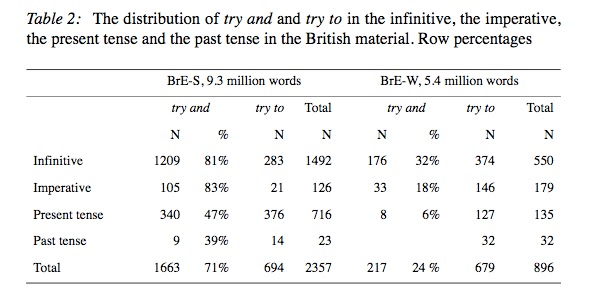
Here's what Hommerberg and Tottie (2007) found for British Spoken and Written data and for American Spoken and Written.

In the forms that can't have suffixes (infinitive and imperative), BrE speakers say try and a lot more than try to. They write try and less, but in in the infinitive, it's still used about 1/3 of the time.

Brook and Tagliamonte found that BrE speakers under 45 use try and over try to at a rate of about 85%, regardless of education level. But for older Brits, there's a difference, with the more educated mostly using try to

AmE speakers sometimes say try and, but they say try to more. They hardly ever use try and (where it could be replaced by try to) in writing.
Brook and Tagliamonte find much the same difference for British English versus Canadian English.


The "non-standard"ness

Though the try and form goes back before American and British English split up, its greater use in Britain is the innovation here. The try and form only started to dominate in Britain in the late 19th century.

Brook and Tagliamonte note that it's "curious" that BrE prefers try and when it has "two ostensible disadvantages":
  1. it's less syntactically versatile, since it doesn't like suffixation,
  2. it's long been considered the "non-standard" form, repeatedly criticized in even British style guides. 

On the second point, Eric Partridge's Usage and Abusage (1947) calls it "incorrect" and "an astonishingly frequent error". However, other British style guides are much more forgiving of it. While the third edition of Fowler's Modern Usage (1996) says that "Arguments continue to rage about the validity of try and", it notes that the original 1926 edition said that "try and is an idiom that should not be discountenanced" when it sounds natural. The Complete Plain Words (1986) lists it in a checklist of phrases to be used with care ("Try to is to be preferred in serious writing"), but it got no mention in  Ernest Gowers' original Plain Words (1948) or the recent revision of the work by Rebecca Gowers (2014). Oliver Kamm's rebelliously "non-pedantic" guide (2015) calls try and "Standard English".  Other British sources I've checked have nothing to say about it. Though it's only recently climbed the social ladder, British writers and "authorities" seem, on the whole, (BrE) not very fussed about it.

American guides do comment on try and. Ambrose Bierce (1909) called it "colloquial slovenliness of speech" and Jan Freeman (2009) calls it "one of the favorite topics of American peevologists". The dictionaries and stylebooks that are less excited about it at least pause to note that it is informal, colloquial, or a "casualism". The American Heritage Dictionary notes:
To be sure, the usage is associated with informal style and strikes an inappropriately conversational note in formal writing. In our 2005 survey, just 55 percent of the Usage Panel accepted the construction in the sentence Why don't you try and see if you can work the problem out for yourselves?
(I can't help but read that to be sure in an Irish accent, which means I've been around Englishpeople too long.)

One hypothesis is that try and came to be preferred in Britain due to horror aequi: the avoidance of repetition. So, instead of Try to get to know, you can drop a to and have Try and get to know. The colloquialism may have been more and more tolerated because the alternative was aesthetically unpleasing.

Try and is an example I'm discussing (in much less detail) in the book I'm writing because it seems to illustrate a tendency for British English to make judg(e)ments "by ear" where American English often likes to go "by the book". (Please feel free to debate this point or give me more examples in the comments!)

Garner's Modern English Usage

And so, on to the app.  The Garner's Modern English Usage (GMEU) app is the full content of the 4th edition of the book of the same name, with some extra app-y features. I've tested it on an Apple iPod, but I think it's available for other platforms too. On iTunes, it lists at US$24.99.

Full disclosure: Bryan Garner gave me a free copy of this app in its testing stage.  I've met Garner in person once, when I'm quite sure he decided I was a hopeless liberal. (The thing about liberals, though, is you can't really be one without lots of hope.) He's a good one to follow on Twitter.

Sad disclosure: I received the offer of the free app not too long after I ordered a hard copy of the 4th edition, which (AmE) set me back £32.99, and, at 1055 pages, takes up a pretty big chunk of valuable by-the-desk bookshelf (AmE) real estate. I bought that book AFTER FORGETTING that just weeks before, hoping to avoid the real-estate incursion, I'd bought the e-book edition for a (orig. AmE) hefty $34.99. So, although I got the app for free, I expect to get my money's worth!!

So far, the app works beautifully, and is so much easier to search than a physical book. Mainly, I've used it for searching for items with AmE/BrE differences. I also used it to argue back to a Reviewer 2 who was trying to (not and!) (orig. AmE) micromanage aspects of my usage that don't seem to have any prescriptions against them (their absence in GMEU was welcome). (Reviewer 2 did like our research, so almost all is forgiven.)

GMEU didn't have everything I looked up (see the post on lewd), but that's probably because those things are not known usage issues. I had just wondered if they might be. But where I looked up things that differed in BrE and AmE, the differences were always clearly stated. Here is a screenshot of try and:


Garner's book is so big because it's got lots of  real examples and useful numbers, as you can see in this example. Nice features of the app, besides easy searchability, include the ability to save entries as 'favorites', tricky quizzes (which tell me I qualify as a "true snoot"), and all the front matter of the book: prefaces, linguistic glossary, pronunciation guide, and Garner's essays about the language.

The search feature gives only hits for essay topics and entry headwords. That is probably all anyone else needs. I'd like to be able to search, for instance, for all instances of British and BrE to find what he covers. But I guess that's what I can use my ebook for...

Over the course of his editions and his work more generally, Garner has included more and more about British English, but at its heart, GMEU is an American piece of work. Other Englishes don't really (BrE) get a look-in (fact, not criticism). I very much recommend the app for American writers, students, and editors, but also for British editors, who are often called upon to work on American writers' work or to make British work more transatlantically neutral.


Read more

The book!

View by topic

Abbr.

AmE = American English
BrE = British English
OED = Oxford English Dictionary (online)