Showing posts sorted by relevance for query football. Sort by date Show all posts

World Cup words

England are (BrE; AmE = is) out of the World Cup competition. For people like me this means an end to excellent crowd-free shopping opportunities. It also means that I should write about the (BrE) football/(AmE) soccer words I've been noticing, before it all seems completely irrelevant.

While British people can watch football games, they're more likely to watch football matches (unless they write for BBC News Online, in which case they're oddly out of step). American English would refer to matches for tennis, but generally not for team sports. If you look up baseball match on Google, you find the source is generally Australian, European or US-immigrant.

Of course, the sport itself is referred to as a game--and not just any game, but The Beautiful Game. A well-worn cliché in these parts is Football is a game of two halves--i.e. 'don't count on things staying the same way, they might change'. This is applied to just about anything. Sometimes it retains its original sense, and other times it just means 'X has two aspects':
Attractiveness is a game of two halves. (New Scientist)

New Zealand, like football, is a game of two halves. (The Times (Ireland))

Sisters, like football, is a game of two halves. (CD review on Rate Your Music)

Your report “Virgin’s £30m German peace price” (Business, last week) reminded me of the fact that business, like football, is a game of two halves. (The Sunday Times (UK))

(I haven't found the original source of this phrase. Anybody know?)

This World Cup has seen the coining of a new tabloidific word. (And it's not tabloidific, which I just made up all by my lonesome--you can googlewhack it with any other word on this blog.) It's the acronym WAGs (pronounced [wægz]) for 'Wives and Girlfriends', but also used in the singular, where the acronym doesn't make as much sense:
For those footballer W.A.G. (Wives And Girlfirends!) wannabees, we've cherry-picked some fabulous designer goodies to have you looking as high-maintenance as Victoria, Colleen and Cheryl in no time. (Tiscali shopping site)

Presumably this term was born out of frustration with the thwarted desire to refer to Footballers' (AmE=Soccer Players') Wives--thwarted, that is, by the marital status of many of the most watched football couples. Marina Hyde at the Guardian pegs it as "what promises to be this year's most tediously predictable new OED entry" and it was last week's Word of the Week at Macmillan English Dictionary's site. It's not a very kind term, since wag also means a joker, but footballers' wives (and girlfriends) are treated as a kind of national joke anyhow.

Are there any wives of American sports figures who are famous just for being wives of sports figures and shopping a lot?
Read more

fixtures and brackets

It's FIFA World Cup Time, a fact that is hard to avoid in this part of the world. I am not the kind of person who’s interested in watching it, regardless of who’s playing or where it’s being held. But I'm nothing if not opportunistic, so I'll use this as an excuse to write about some linguistic differences related to sport(s) more generally. 

It’s old news that the British mostly call it football and Americans mostly call it soccer. It’s even older news that the name soccer is actually British. To quote myself (from The Prodigal Tongue):

Britain, Americans call your football soccer because you taught them to. Just like rugger is a nickname for rugby football, soccer came from the full name of the game, association football. The word comes from England. You should be proud of it. 


But that’s not the difference I want to feature this time. I want to talk about fixtures. If your eyesight’s good (the words are very faint, for some reason), you can see the term repeatedly used on the local team’s website (I've added the purple boxes to highlight them):


BrE fixture in this sense means ‘who’s "fixed" to play whom when’. In the plural, it's the whole list of who's playing whom when. It's a necessary word at any kind of tournament in the UK. I initially learned it through tournament Scrabble (at my first UK tournament 22 years ago), and I recall it (probably orig. AmE) throwing me for a loop then.


You won’t see the word fixtures on most American sports sites or advertising. Instead, you’ll see schedule, as seen here for my "local" (BrE) American football /(AmE) football team back in the US:


In The Prodigal Tongue, I cover the strange history of the pronunciation of schedule. (If you haven't read it, tell Santa. Or your nearest bookseller.) In that discussion, I note that the word schedule is used much more in AmE than BrE, because BrE uses other words for the things Americans call schedules in various contexts. Words like: timetable, programme, and fixtures.


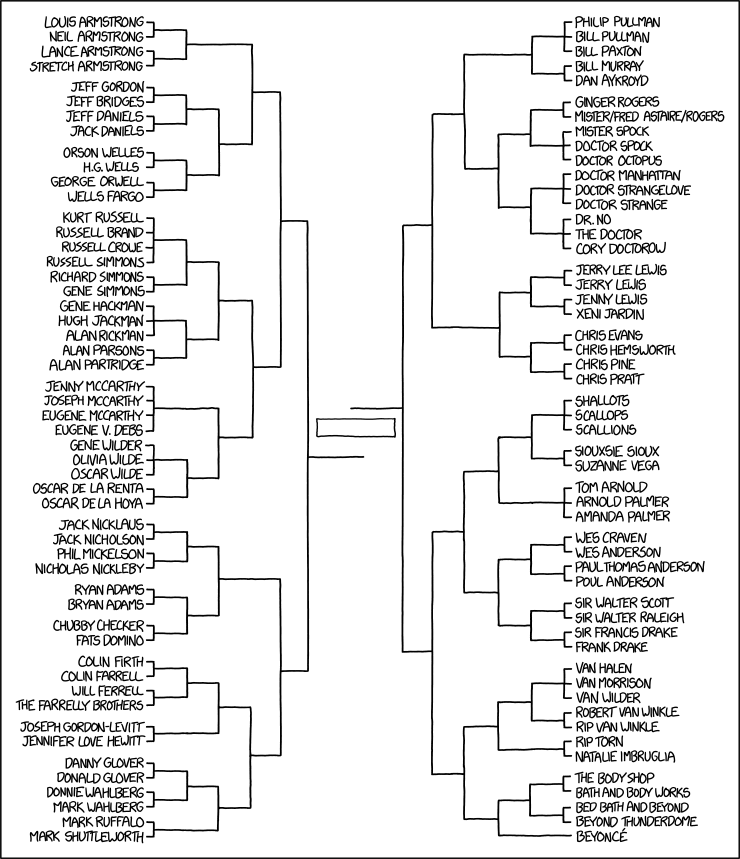
A related term is AmE bracket, which derives from the use of this kind of diagram for showing who's playing whom in an elimination tournament. (For more on differences in the punctuation term bracket, see here.) Randall Munroe, at his comic xkcd,  has done some fantastic brackets, like this one, which I will share because we've had enough sports talk now, haven't we?


click image to enlarge


In BrE one might instead talk about the draw, i.e. who's been "drawn" (as if from a hat) to play against whom. Bracket is a bit different from draw because it's not just who's playing whom in the initial random arrangement, but also eventually who's playing whom all the way up the various rounds of competition. 


And speaking of draw, England were drawn against USA this week, and it ended in a 0–0 draw, which could also be called a tie. Tie is generally more common in AmE, but it's used in BrE too.

Here's 'ended in a tie/draw' in the News on the Web corpus:


If you’re interested in more football/soccer-related content, here are a couple of posts:


And in case you missed it, I now have a (hopefully usually) weekly newsletter in which I will be sharing news of new blog posts (like this one) and other US/UK and linguistic content.
Sign up here if you haven't already!
Read more

scrimmage and scrummage

A while ago, I mentioned the (BrE) rugby term scrum and compared it to the AmE (regional) term dogpile. Chris E wrote today to ask a related question--which jumps to the head of the question queue because it's so simple to answer. Chris wrote:
If you are both a rugby and American football football fan, you will notice many obvious similarities between the two. I played rugby at school in England in the 70s and became familiar with the term scrummage, shortened to scrum in most usage nowadays. In the US, I have understood the word scrimmage to mean at least two things - 1. a term generic to many, if not all sports, meaning a practice game (a friendly in BrEng) 2. a specific American football term with which I'm not familiar.
Can you comment on the root or roots of these? I feel confident that they share a common heritage, but I don't know for sure.
It's simple to answer because the OED does all the work for me. (I can't claim to understand American football and am completely clueless about rugby.) In the OED, scrimmage and scrummage are treated as variations on the same word, and the etymology is given as:

[Altered form of SCRIMISH n., the ending being associated with -AGE suffix. Cf. the parallel skirmage, obs. var. of SKIRMISH n.

This is now used primarily as a sporting term. The older i-form is common in all senses, and has become predominant in American Football, whilst the u-form is preferred in Rugby Football.]

So, yes, they share a common origin. But the fun thing (for me, tireless defender of Englishes*) to notice is that we (again!) have a case of British people messing around with the language and Americans staying true to the original form--contrary to the popular stereotypes. Not that messing around with English is a bad thing, of course. After all, we wouldn't have poetry without some messing around.

* Actually, that's a lie. I'm a very tired defender of Englishes. The tiredness has little to do with the defending, though.
Read more

up the albion!

From the "Up the Albion" Facebook page
The comments on the last post mostly cent{er/re} around uses of up as a verb...which led me to recall one of my first encounters with a BrE sense up. (This one a preposition.)

It was on the back of a bus, and it said: UP THE ALBION!

Now, the Albion is Brighton and Hove Albion, also known as the Seagulls, the local (BrE) football club / (AmE) soccer team, so I was puzzled as to why the local bus company would want to say something rude about the local team. You see, in AmE I would have to say up with the Albion (reminding me of a slogan from my childhood, Up with People). Without the with, I could only presume that I should interpret it as I interpret Up yours, which is a rude thing to say wherever you are.

Better Half says that Up the Albion! is a kind of cheer that one used to hear on the terraces, but these days one is more likely to hear You are going home in a fucking ambulance! (he sang that, but I can't figure out how to give you a sense of the rhythm) or some of the chants available on this website. (I'm sending you to the Albion page, but there are lots more on that site for other clubs too. For an intro to football chants, see also this BBC site.) Terraces in this sense means steps or tiers where people stand to watch the (BrE) match/(AmE) game. They're kind of like (AmE) bleachers, except that they're for standing, rather than sitting. Terraces are becoming a thing of the past (whereas increasingly abusive football chants are not), because of safety concerns, following a number of horrible incidents in the 1980s (including and especially the Hillsborough disaster). New stadiums have seating throughout.

Of course, there are other ways in which up is used differently in AmE and BrE, but they'll have to wait until I haven't got so much marking/grading to do.
Read more

chav

A recent list of American (well, North Carolinian) university student slang includes the word chav, defining it as:

CHAV - working class boor. From British slang. "“This club used to be nice, but now it's full of chavs."

I find this borrowing of the British term a bit sad, since it necessarily involves some semantic shift or drift. It's not so much that I'm against linguistic change and borrowing, but chav describes a very particular social phenomenon, which is generally not found in the same way in the US--with the notable possible exception of Britney Spears. The word becomes less useful if it just refers generally to 'working class boors'.

Britain, on the other hand, does not have exact equivalents of the American phenomena rednecks, trailer trash or wiggas, although there are overlaps between the latter two and chavhood.

A key difference between the US and UK social stereotypes is their relation to race and class issues. The US categories all implicitly or explicitly reference race--rednecks are whites who stereotypically have racist attitudes, trailer trash is a subcategory of white trash, and wiggas are (typically/originally upper middle class) whites who emulate 'urban black' styles. While chavs are generally white, and while their style and slang often echoes an 'urban' Black American aesthetic (e.g. bling), the relationship is less direct than for wiggas. Football (AmE: soccer) also plays a heavy role in chav style, whether in emulation of favo(u)rite players (or their wives), or in the display of football-nationalistic symbols (e.g. England team wear). Click here for a football-themed post on World Cup words.

Chavhood is also associated with Gypsydom, although more through shared stereotypes than actual lineage. The word itself is thought to be Romany in origin (see Michael Quinion's excellent site), and pikey, an offensive word for Gypsies (or Travel(l)ers, a preferred term in Britain), is often used as a synonym for chav.
Read more

special(i)ty, newspaper editing jargon and dogpile

As the title reveals, this post is a (AmE) hodgepodge/(BrE) hotchpotch of unrelated topics, which will serve the purpose of (a) finishing up the queries from April, and (b) writing a quick entry in a really busy week. (It's both Lynneukah [the joyous festival of Lynne] and week 1 of the university term. One of those is more entertaining than the other.)

Terry wrote back in April, pointing out that I'd failed (as I'm sure I often do) to mark a BrE/AmE difference that I'd used in passing: (AmE) specialty versus (BrE) speciality. There's not much more to say about that, except that in BrE specialty is used in the field of medicine, at least according to the Oxford Dictionary of English.

But in the ensuing correspondence, Terry called my attention to quite a bit of newspaper editing jargon that differs between the US and the UK. Terry is a (BrE) sub-editor/(AmE) copy editor, and the differences do not stop at the job title. Here are the ones he listed--and as far as I can tell, the American versions come first in this list:
... there's a surprising amount of difference in terminology between US papers and Brtitish ones: "slot" and "rim" (from where people sit at the horseshoe-shaped copy desk) versus "chief sub" and "down-table sub" for example, indicating American and British newspapers used differently shaped tables; "hed" versus "headline" and "lede" versus "intro" (ie opening sentence - a "lead" (pronounced [in the same way as] "lede") in BrE journalism, would mean the whole main story on a page, not just its intro); "cutline" for "caption", "graf" instead of "par" for paragraph, "refer" for "cross-ref", the line at the foot of a story that cross-refers to another story elsewhere in the paper, "slug" for "catchline", the short name given to a story for tracking purposes; "soft strip" for "strapline", a long subsidiary headline.
Terry's the expert (compared to me, at least!), so I'll leave it at that. I should add that of course headline is an AmE word too--it's what most people would call a headline. His inclusion of hed here should be taken only as jargon use, not as general AmE. Similarly, as a layperson speaking AmE, I'd refer to captions, not cutlines, so again this is about the jargon that copy/sub-editors use, not what newspaper readers use. Are there other copy/sub-editors reading who'd like to add anything else?

Finally, Terry made the following request:
If you ever do a(nother) piece on words common in the US that not one in a thousand Britons would understand, can I nominate dogpile? I never heard the word until coming across the search engine of the same name, and it was another five or six years before I learnt what a dogpile was - BrE scrum - and realised why the search engine designers had given it that name, because it piles results from other search engines up together ...
As you can see, I'm relying on Terry to write the bit on dogpile. The thing is...I don't know how many AmE speakers know the word either. I certainly had never heard it before I came across the search engine. Perhaps it's something that all (American) football fans know (I exclude myself from that category), but I've never heard it used in my Buffalo Bills-loving family. The OED added an entry on it earlier this year:

1. A disordered mass or heap of people, formed around an individual on whom others jump. Also fig. Cf. PIG PILE n.

1921 Nebraska State Jrnl. 19 Nov. 3/1 Purdy tucked the pigskin under his elbow and cantered over a dog-pile for a tally. 1948 Los Angeles Times 21 Nov. I. 20/2 The bottom man of a ‘dog pile’ in a fraternity house scuffle is in a hospital with a neck dislocation. 1993 Toronto Star (Nexis) 25 July E1 The AL West is a dog-pile similar to the AL East. Several teams can win. 2003 A. SWOFFORD Jarhead 20 The half-speed fight degenerates into a laughter-filled dog-pile... This is fun, plain mindless fun.
It's not clear to me that scrum is used in the same extended ways as dog-pile. The OED's second sense for scrum is: 'A confused, noisy throng (at a social function or the like)', which could involve a lot of standing people:
1976 Eastern Daily Press (Norwich) 19 Nov. 1/4 Cindy, as the new Miss World likes to be called, was surrounded by the traditional scrum of over 100 press photographers.

Thus I believe (though I'm not a rugby person either) that scrums are more 'vertical' than dog-piles. Here's a picture of a scrum from the MIT women's rugby site:


And here's a picture of a dog-pile (full of baseball players, not football players!) from the Santa Barbara Independent:


Scrums seem to have people on their feet more often than dog-piles do.

According to About Football Glossary, another (presumably less slangy) term for dog-pile is piling on, and it's a punishable offen{c/s}e in the game.

Finally, one has to question the wisdom of naming a search engine Dogpile, since the second (AmE) meaning for dog-pile is given in the OED as: 'A piece of dog excrement.' So, you can go with the metaphor of the search engine piling on results from other search engines, or you can substitute the metaphor that the Internet is full of this stuff.

Read more

bowls

I'm embarrassed by how much television I've been watching lately. On further reflection, perhaps that's not true--maybe I'm just embarrassed by how much television I've found myself admitting to watching. But it does raise lots of bloggable issues, so here I go again with the admitting.

Better Half came home tonight to find me watching The Big Bang Theory with a sleeping baby on my lap. (My excuse: I was stuck--I couldn't very well disturb the baby, who hates to nap and so must be tricked into doing it on my lap. So, nothing to do but power up the remote control.) In this episode, the boys are preparing for the "Physics Bowl". When they started practi{c/s}ing for the Bowl with physics quiz questions, BH said, "Oh, that's what they're doing! I couldn't figure out why physicists would get so excited about bowling!"

The AmE bowl in Physics Bowl is the same as the more general College Bowl--a contest between (usually) students in which they answer (usually) academic questions. The UK equivalent to the College Bowl is University Challenge, a television program(me) in which students from different universities (or colleges within the Oxbridge/London universities) compete on television. (Perhaps some Americans will have seen this in the book/film Starter for Ten--if it was released over there...) University Challenge was based on the College Bowl, but it has overtaken its ancestor in terms of popularity. The College Bowl was televised in the US from the 1950s until 1970, but University Challenge is a television institution that's still very popular today. My own bowl experience was to be in the History Bowl when I was in the 8th grade. In that case, it was a county-wide competition for which I had to learn much more than I ever wanted to know about the Erie Canal. (I stayed home on the day of the final, insisting that I was [AmE-preferred] sick/[BrE-preferred] ill, but I think my mother was right in insisting that it was just butterflies. Oh, the regret.)

I'm fairly certain that the name of these kinds of contests (which hasn't made it into the OED or American Heritage) is derived from the use of bowl to refer to certain post-season football (=BrE American football) games, such as the Rose Bowl, which are played between (AmE) college (= BrE university) teams. (Plus the Super Bowl, which is played between professional teams.) They are so-called because of the bowl shape of the stadiums (or stadia, if you prefer--the spellchecker doesn't) in which they were first played.

The kind of bowl(ing) that Better Half was imagining is generally called bowling in AmE, but ten-pin bowling in BrE. (In AmE bowling can also refer to variants like candlepin bowling. You can look these things up if you'd like to know the difference! The social class implications of bowling in America are noted in the comments of a recent post.) This distinguishes it from the game more traditionally played in England, (lawn) bowls, which is closely related to the continental games boules/pétanque and bocce (which is the more familiar game in America, thanks to Italian immigrants). Another kind of bowling found in the UK (more than the US), particularly in the Southwest, is skittles, the game from which modern indoor bowling is derived. This provides me with an excuse to post one of my photos of the Children's Parade in the Brighton Festival. This year the theme was favo(u)rite games, and one school chose skittles. (It's not the best photo I took, but I've suddenly had qualms about posting a photo of other people's children.) In the US, I imagine most people would associate skittles with a (AmE) candy/(BrE) sweet.

(...which compels an anecdote. I was at a party in Waco, Texas once and met a man who told me he was in Research and Development at M&M/Mars, one of the bigger employers in town. I asked what he'd developed. His wife proudly put her arm in his and beamed, "He invented Skittles!" As you can see, one meets Very Important People in Waco. And I should join Anecdoters Anonymous.)

The verb to bowl is used to describe what one does with the projectile in all of these games, but is also used to describe how the ball is delivered (or not) to the bat in cricket--and hence the person who does that delivering is the bowler. The closest thing in popular American sports is the pitcher, who pitches a baseball.

Going further afield, another bowl that differs is found in the (AmE) bathroom/(BrE informal) loo. While AmE speakers clean the toilet bowl, BrE speakers stick their brushes into the toilet's pan. I'm not absolutely sure that BrE speakers don't also use bowl in this sense (do you?), but it jars whenever I hear people speak about the toilet pan, as it makes me imagine something very shallow.

Those are the bowl differences I've noticed myself, although the OED also gives a special Scottish English sense: a marble. Their only example is from 1826, so you Scots will have to tell us whether it's current!
Read more

the c-word and gendering mansplaining

In 2011, Douglas Bigham asked me if I'd write a piece about "the c-word" for the Popular Linguistics website, which he was trying to get started at the time. He observed:
It *seems* to me that "c---" is less gendered in the UK, but can only be directed at a woman in the US.
(He didn't censor the word, but I have. I'd say it in a linguistics lecture, but putting it on a page is a bit too in-your-face for a blog that wants to be used in schools. I think I've screwed my chances with the nanny software already, though. Of course, I'm talking about the word that's an anagram of the name of a certain Danish king.)

The article never happened (I'm sorry!) and the site closed (I hope unrelatedly, but I will admit my contribution by non-contribution, if necessary). But today I am moved to write a bit about the word because of this (slightly censored for this blog) message I got on Facebook this morning:


I will come back to why I got this message and why I've hidden his full name. Let's just deal with the BrE/AmE difference first.

This message looks like it's from the USA (and his Facebook profile agrees), because he called a woman a 'dumb c-'. Looking at the GloWBE corpus, there are two unique instances of this phrase in the American data. Both refer to women. There are five in the British data and they refer to: a male athlete, a male friend, and fans of a certain football team or football magazine. This is not to say that it can't refer to either sex in either country, but there are definite different tendencies, and they give the word a different feel in the two places. The shift from feminine to masculine in BrE is (of course) part of a more general tendency to use words for women (or our parts) as the ultimate way to put down a man. Which just sums up the status of womanhood in our culture rather neatly.

(The data for stupid c--- are a bit more mixed, but still tending toward(s) AmE=female, BrE=male. And, as we've seen before, the nationality of GloWBE data is probably 15-20% corrupted by the internationality of web data.)

In the UK, the word is thrown around rather easily among men. It can be used among friends in a playful way, but more often (as far as I can tell) it is a term of abuse for men they don't like. The statistical analysis in the GloWBE corpus marks it as a particularly British word, with 1634 British uses to 467 American ones. The statistically "most British and not American" words to come before it are that, fat, black, some and the. (The American data shows up no 'strongly American' collocates.) That shows us that it's often used referentially in BrE--i.e. to talk about people rather than to address them directly, as in "Some c- of an economics analyst on BBC News 24 just tried to equate...".

The British can be amused by how much this word offends many Americans. And it does offend. For me in my American state-of-mind, only certain racial insults are viler than this word. It was a very long time before I could say it out loud at all (I don't think I ever even heard it till [AmE] college/[BrE] university), and I am not usually one who is shy about words.

But the intent with which words are uttered is what really matters and this reminded me of something else that happened recently:
This was in the UK, and what the man yelled (really aggressively at a woman in an open-windowed car) was "YOU STUPID COW". While cow isn't a taboo word, it can be used very aggressively (and also often playfully) to refer to women in BrE. (Worth noting here that everyday life in the UK provides ample evidence against the American stereotype that the English, as a people, are polite.)

I wouldn't claim that  cow got started as a substitute for the coarser anatomical word (women have been insulted by all sorts of animal names for centuries), but I think that in cases like this road-rage incident there's a link. The former c- word for women is now used for men, but cow provides a similar articulatory gesture.

I've seen lots of cases of women reclaiming the c-word as an anatomical term, but less so reclaiming it as a word for people, rather than people-parts. (Compare the word for a female dog, which has been reclaimed often as a word for women showing strength of character in the face of sexism.)

a bit on the mansplaining...

I'd like to say a bit about what led to this point. It started when the Linguistic Society of America shared a link on its Facebook page:


That's a bad piece of  (AmE) subhead /(BrE) standfirst writing. What it means is that studies are equivocal about whether bilingualism helps cognitive development. What it says is that there might not be any advantage to bilingualism. Linguists know well about these debates, and so I posted an ironic comment on the article:
"not show any real benefits"? Like speaking two languages isn't a real benefit?
I later added a smiley face. But without the smiley face  Mr Jason, above, felt the need to explain to me that there are studies that have said that there are cognitive benefits of bilingualism and other studies that have said there are not. (He deleted his explanation before I received his personal message.) I went back-and-forth in my mind a bit about how to respond to it, and I went with this comment-reply:
Sorry, is this what they call 'mansplaining'? It was a critique of the phrasing. I do know this. I do teach it!
And in the morning, I got the private message you see above. Before reporting him to Facebook and blocking him, I did get a look at his public profile. According to that, he had studied English Applied Linguistics at a Wisconsin university less than 10 years ago. I am not including his full name here, because, honestly, it's not worth whatever further abuse he might be willing to give. I have once before received a very similar Facebook message from another  young man (that one in Ohio) after I beat him repeatedly on an online game and he accused me of cheating. (I no longer play on-line games against people I don't know.) I know a male Scrabble champion who gets such cheating-accusation abuse all the time. All they needed to do was google his name to know how silly their accusations would sound. But that seems to be expecting too much of some people. So here are some helpful rules if you want to insult people on the internet.
Rule #1 for insulting people on the internet: find out who you're insulting first.
Rule #2 for insulting people on the internet: don't insult people on the internet.
(I bother with rule #1 because you might learn something interesting. )

Now, you might say here that I did not follow rule #2. I would disagree that I literally insulted, though I will admit that it seems to have had the same effect. I used the word mansplaining in order to call out a behavio(u)r. I did not call the person anything. Maybe that one needed a smiley-face too.

I had weighed whether to call it mansplaining (and even when I did, I did so indirectly), but in the end I went with it (and even got a 'like' and a supportive message about it). I've posted this Jason's message on my Facebook page and have been discussing it with my friends this morning. One (male) friend, whil{e/st} being sympathetic to my situation and angry on my behalf, said
this is why I'm not a fan of the word 'mansplaining'. Let's not taint the name of a whole gender because of these morons.
And I've got mixed feelings about that. I replied (in part):
I have had my joke explained to me three times and it has been by a man each time. Any genitals-free behavio(u)r can be done by anyone, sure, and I have used 'mansplain' at least once of a woman, but that doesn't mean it's not gendered behavio(u)r. Just like I argued two weeks ago(?) that I felt it important to call out creepy behavio(u)r as 'creepy' I think this needs to be called out for what it is. [...C]alling it out with the 'man' is to acknowledge male privilege, and I think men (and whites and straights) need it pointed out once in a while that they are coming from a position where they've assumed some things based on that privilege. I 40% agree with you, but I 60% agree with me.
The creepy thing relates to another debate with my Facebook friends. When an inappropriate appreciation of my photo was posted in the '10th blogiversary' post, I went back and forth a bit about whether to just delete the comment or to thank him for the other part of the comment, followed by "but let's keep it non-creepy, please".

In that case I got a mix of advice in both directions. I put up the "thank you for your kind comments on the blog, but please let's keep it non-creepy" comment and deleted it almost immediately (I don't know whether the post will have gone out to people who were following the thread by email) and then deleted his comment (because I do have a comments policy and I just didn't want to spend my time debating it with strangers). I found it interesting that several female friends suggested paraphrases of the comment (mostly without the warm thanks part) that changed creepy to inappropriate or that asked for "no personal comments, please" or that I not post a photo of myself. I reacted to those suggestions [in part] with:
I don't mind personal comments. I don't like creepy comments. If I'm going to [comment on] it, I'm going to say 'creepy'. [...]  'Inappropriate' doesn't tell him what was inappropriate about it. Creepy does. Some guys don't reali{s/z}e what creepy is [...]

I post pictures to be more human. Having a face isn't an invitation for somewhat sexual comments about it. I do have a comments policy where I say that I reserve the right to delete things that aren't in the spirit of helpful conversation. But I'm not interested in banning comments about appearance. If someone says "You look just like one of my cousins!" or "I think your hairstyle has got more British while you've lived there" (I don't think it has!), that can be a bit of fun.
So, as I said above, I 60% think that when unfortunate behavio(u)r is gendered, it's important to point out the genderedness of it. That way, you hope that the person who's creeped you out, or exasperated you, or insulted you might go ahead and think about their sociali{s/z}ation to act in this way and to maybe pause to think a bit more about the things they've been led to believe about the world.  Maybe before "helping"  someone who's said something that they think "needs help", they might pause to wonder whether there's another possible interpretation of what she's said (it could have been a joke) or whether she might know more about the topic than you do.

The act of explaining things to people who don't need an explanation can be done by any gender of person to any other gender of person, sure. And it is usually done with no malice. But there's a reason it's been called 'mansplaining' and it is exhausting. Women get their jokes misunderstood or explained to them because there is a cultural assumption that women aren't funny. Many men (in many cultures) are put in positions from childhood where they are listened to, treated as authority, expected not to keep quiet and play along. And so on and so forth.

The main reason not to call out genderedness of gendered behavio(u)r (the other 40%--but it's important to note that my 60/40 split sometimes reverses) is that it makes people defensive when they're treated as a phenomenon and not an individual. And so they might not learn. But if the genderedness isn't pointed out, then they might not consider everything there is to learn there. I tweeted my ironic comment (my joke, if you will) as well:


At the time I'm writing this, 30 people have retweeted it, and 80 have 'liked' it, so I think many are getting the joke. But another three men have tweeted back to 'explain' the line about 'no real benefit of bilingualism' to me. Another follower called one of them out for mansplaining, and the explainer protested that he hadn't mansplained--he just hadn't read the article. So to him, explaining an article you haven't read to a person who has read it (and made a joke about it) isn't mansplaining. To me it is a perfect example. But it may well be the naming of it as a gendered behaviour that (apparently) kept him from thinking more deeply about the matter. This is why sometimes my 60/40 thinking flips to 40/60. I could try to deal with the situation by saying "let's all be good humans and treat each other with respect", and that's what I want in the end. But I think it's hard to think about what "being a good human" means without being able to reflect on sexist privileges, beliefs, and behavio(u)rs. If you've grown up male (and comfortably masculine) in a culture where masculine power and the masculine point-of-view is the default, then your perspective on what it means to be treated badly in that culture starts from a position with a limited view.

Of course, the other reason not to point out sexism is that there are a lot of scary men out there. They send threatening messages. They call the other scary trolls' attention to you. And in Jason's land they're allowed to own guns. America has become a violent opera about the dangers of damaged masculinity. It's a complete Catch-22. Don't call out sexist behavio(u)r, and sexist behavio(u)r is allowed to thrive. Point out sexist behavio(u)r and you might have to live with more (and worse) of it.

(I'm sticking to sexism here, but I think the argument and the dangers are fairly transferable to other kinds of discriminatory structures and behavio(u)rs and the privilege they create. But that might not be for me to say!)

In case you are ever accused of mansplaining or any other kind of unhelpful 'splaining, here are some responses that you might consider:
"Whoops! Sorry about that!"
"It hadn't occurred to me that I was doing that, but thanks for pointing it out."
"Fair enough. Never mind!"
"Hm. That's given me something to think about, thanks."
If you use the last one, please note that you can do the thinking without involving the person who felt mansplained-to. Don't expect them to give you a sticker for working it out. Don't expect that they want an argument about why what you did wasn't really mansplaining. Just take it as someone else's observation on your behavio(u)r. (You don't even have to reply at all on social media.) And then, if you want to be helpful, try to see it from their side.

on  irony

And, yes, it's dangerous to try to achieve irony on the internet. Next time, I'll try to remember the smiley face. British people often comment on Americans' alleged inability to interpret ironic statements (here are two old posts about that: one two and a BBC piece on the matter). There are definite regional differences in this, however, and that may have been a factor here.  I'm a northeasterner. (It may also be relevant that I'm an academic.)  I do irony, and I enjoy it when others enjoy it too.

p.s. avoiding mansplaining

I forgot to add my easy mansplaining-prevention tips for any gender:
  1. If you feel the urge to explain something (especially to a stranger, especially on social media), pause to ask yourself: was I asked a question? 
  2. If you were asked a question, consider: might this be a rhetorical question?
  3. If you weren't asked a non-rhetorical question, there is no need for you to explain.
Regarding the second item: it's not a bad idea to avoid rhetorical questions in writing.
Regarding the third item: this doesn't mean you can't have a conversation about the topic. But rather than trying to explain, you could ask a question and find out more about the other person's relationship to the topic. You could say why you too think the topic is interesting. There are many things you could do that don't involve making yourself seem like a mansplainer...

p.p.s. I've reali{s/z}ed that you can't search for this post on the blog because I've been coy. So: cunt.
Read more

UK-to-US Word of the Year 2024: fortnight

So much of the "news" this year was about female popular music stars. The year started with Beyonce going country, then Charlie XCX declared a brat summer (leading Collins dictionaries to declare brat their Word of the Year). Facebook keeps feeding me videos of Ariana Grande acting and interviewing, and an incredible number of my middle-aged (and beyond) friends went to see Taylor Swift. Album-of-the-year lists are filled with female solo artist megastars. 

It is Ms Swift who gives us our UK-to-US Word of the Year:

fortnight

This is the title of the single she released in April, co-written by Jack Antonoff and featuring Post Malone. It has been nominated for Record of the Year in the 2025 Grammy Awards. Thank you to Helen Zaltzman for nominating the word!


The single's release has resulted in a leap in the word's occurrence in US news:

Ben Yagoda noticed US use of fortnight all the way back in 2012 on his Not One-Off Britishisms (NOOBs) blog. But as the above graph shows, it was not much more than a one-off then. Its last peak (in US usage) came in 2018. The game Fortnite was released in 2017 and took over the world in 2018. This seems to be unrelated to the fortnight surge, which seems to come from the news story about the Thai boys' football team rescued after two weeks trapped in a cave. US news outlets repeated sentences with the word fortnight from non-US news agencies, including Reuters. A fair proportion of the 2018 number are also from US versions of foreign-owned sources like The Guardian and Al Jazeera

Since 2018, it's had more usage than before. To a point, that is because more non-US sources have US web presences—so for example, 2021's US fortnights include a lot of cricket commentary from The Hindu and Omicron-variant tracing in The Guardian. Nevertheless, there is evidence there of growing familiarity with the word in the US since 2018:

painfully losing to Bill Belichick and Brady over the past fortnight.  [nfl.com, 21 Dec 2021]  

Since their [Korean band BTS's] fortnight in L.A., which turned out to be a mere reprieve for artists and fans [Hollywood Reporter, 29 Dec 2021]

...as NYC is currently recording 3,761 daily Covid infections, a 55% increase in a fortnight [deadline.com, 10 Dec 2022]

By 2023, far more of the American fortnights seem to be homegrown. Many of those are about sport(s) and many of those are about European football (AmE: soccer). But a good few (like the nfl.com one above) are about US sports. It's possible that the sports pages, "a NOOBs hotbed" are the entry point for the current fortnight trend

One could think that the sports connection is what made Swift aware of the term—but I think it's a word that poetically minded and well-travel(l)ed Americans would often know. So I'm not going to bet that the inspiration for the word use was Swift's involvement with an NFL player

The song ends with some American geographical detail:

Thought of callin' ya, but you won't pick up'Nother fortnight lost in AmericaMove to Florida, buy the car you wantBut it won't start up till you touch, touch, touch me

It feels like the juxtaposition of fortnight and America is a nod to the unAmericanness of fortnight


Linguistic Americanness/Britishness depends on how you define Americanism and Britishism. This one is British because it died out in the US, not because it was never used there. Its new American fame is a tiny drop compared to its early-US use:

We can be fairly certain that increased use of fortnight in twenty-first AmE is related to recent/current British usage rather than revival of previous American usage. I don't think today's sports pages and pop stars are getting fortnight from Benjamin Franklin.

Note that fortnight been going down-down-down in the UK too. British people are saying two weeks more than fortnight since around the 1970s:


Some people call that Americani{s/z}ation. I'm not so sure. It's not like two weeks is a phrase an English speaker would have to learn from Americans. It wasn't Americani{s/z}ation when English speakers stopped saying sennight (='seven nights', like fortnight = 'fourteen nights') in the 17th century in favo(u)r of one week or a week. It's just using another, more transparent expression that your language allows, and allowing the more old-fashioned-feeling one to fall away. 


-----------------

At this point, I am not certain there will be a US-to-UK Word of the Year 2024. If you're reading this before I post one, you're still welcome to nominate! 

Read more

Separated by a Common Twitter: competition results!

Thanks to Twitter-followers who re-tweeted to me their nominations for 'most impenetrable to cross-ponder' tweet.  We have a winner, Transblawg (Margaret Marks) who sent two--one that I declare the winner, and one that I declare a runner-up.  First, the winner (I'm deleting the identities of the original tweeters, since they didn't ask to be here...):

KP v.lucky to wring that lbw decision out of Enamul Haque: that was missing off-stump by a mile! Bangladesh 163-5 and in trouble

Of course,  anything with personal initials/names is going to be hard for anyone to read, but with a little BrE knowledge, one can figure out at least what the roles of KP and Enamul Haque are.  The tweet, for anyone who needs translation, is about cricket, the only sport that Better Half follows, but still one whose scoring system has to be explained to me every single time he tries to engage me in a conversation about the game.  KP is Kevin Pietersen, who was (BrE) bowling (equivalent to pitching in baseball--except that it's done differently) and Haque must be an umpire.  'That lbw decision' refers to a leg-before-wicket call made by the umpire.  In this case, spelling out the initials doesn't help much, does it?  You have to know that the aim of the bowler in cricket is to knock the bails (little pieces of wood) from a wicket (three little poles, called stumps, with the bails on top--image from Wikipedia). The batsman (baseball equivalent = batter) tries to hit the ball, preventing it from getting to the wicket.  But the leg-before-wicket law means that the umpire can decide that the batsman is out because the ball would have hit the wicket, had the batsman's leg (or the pads on it) not been in the way.  The three stumps are called the off stump (which is on the off-side, nearest the bat) the middle stump and the leg stump (on the on-side, the leg side).  So, to translate: Kevin Pietersen is very lucky that EH decided that the ball Pietersen had bowled would have hit the stumps, since, in the tweeter's opinion, it was nowhere near the outermost stump.  The rest is the score, to be read as 'Bangladesh is 163 for 5', which means that they've scored 163 runs and lost 5 wickets (yes, I had to look that up).  In other words, you're only told the number of runs for the team that is batting.  The team that gets more runs wins, so you know from this information how many runs the other team needs to get when it's their turn to bat.  But don't expect me to tell you more than that.  Instead, I'll point you to a site where an American tries to explain cricket to Americans.

I'll ask the winner to send her address and her choice of biscuits/cookies to me directly.  Here's the runner-up that she sent:
blooming knackering. I've got a sales conference in a couple of weeks too. I liked garden leave!! boo hoo
And maybe this should have been the winner, since it's not in the jargon of a sport, but in general BrE--but since it means sending the biscuits/cookies to the same place, perhaps I'll just declare it a (BrE-prominent) draw/(AmE-prominent) tie. A glossary for the tweet:
blooming = is a bowdleri{z/s}ed version of the vulgar BrE modifier bloody--akin in this context to saying (AmE) darned.

knackering = exhausting, tiring (slang). 

garden leave (also gardening leave) is, to quote the OED: "Brit. (euphem.) suspension from work on full pay for the duration of a notice period, typically to prevent an employee from having any further influence on the organization or from acting to benefit a competitor before leaving."
Janibach sent the only American tweet among the entries, which was related to American football--and not as impenetrable for the average British reader as the cricket tweet:
Who do you want the Cleveland Browns to take in the draft. Where are they in line? #NFL
The NFL (National Football League) occasionally comes to the UK to play exhibition games, and some games, including the Superbowl, sometimes make it onto wee-hours television.  That doesn't mean that the average Briton knows much about the sport--but still, this one is fairly decipherable (It was the wrong time of year to get tweets about less transparent things like first downs and Hail Mary passes).  Cleveland Browns are pretty clearly a sports team (since they follow the code of city name + plural common noun found in many team names across the English-speaking world).  The AmE spelling of draft for draught has been populari{z/s}ed for several senses of the word even in BrE, and particularly when referring to American military conscription.  While reference to drafts in the context of selecting players for a team may not be usual in BrE, it's part of a general sense that BrE does have: "The withdrawing, detachment, or selection of certain persons, animals, or things from a larger body for some special duty or purpose; the party so drawn off or selected" (OED).  And while BrE speakers would usually say in or on the queue rather than in line, they can certainly understand it.

This probably was an unfair contest in that respect--since BrE speakers are generally subjected to more AmE than AmE speakers are to BrE, a winning tweet would probably have had to use either fairly low-frequency words or very current slang in order to be more impenetrable than the BrE entries.  Ah well.

I'm tempted to go through all the entries (as there were only six), but having spent most of my Saturday night at this already, I think I'll stop and leave the others as inspiration for future blog posts.  Thanks to all who (re-)tweeted!  Catch me in Brighton, and I'll buy you a cuppa (bring your own biscuit).
Read more

2016 UK-to-US Word of the Year: gutted

The day after the US election, it became clear to me that the UK-to-US Word of the Year would have to be the adjective

gutted


The verb to gut is, of course, common to both varieties of English, but in this case I'm talking about an adjectival use of gutted to refer to a feeling of disappointment or sadness that makes one feel utterly emptied. Green's Dictionary of Slang indicates it's been around at least as far back as the 1970s, originally in prison slang.  I blogged about gutted as a Britishism in 2009. Then I shared a story of an American inappropriately understanding its use  in the literal sense 'having had the guts removed', so it hasn't been a common expression in AmE for very long. The events of 8 November certainly put it in American social media feeds. Here are a couple of examples:


Ben Yagoda also noticed it at Not One-Off Britshisms.

The 'devastated' meaning of gutted has been growing in AmE for the last couple of years. A Twitter search today gave me US examples referring to that devastating feeling when the local Chic-Fil-A closes before you (AmE) get off work, when you miss an Ultimate Fighting match, or when you have to give up vlogging. Ok, so some of those would definitely not leave me gutted, but to each their own.

The adjective seemed to come into its own in the US in response to election happenings, when people who had been cruising on optimism for months suddenly felt truly down and hopeless. The New York Times seemed to find it useful:


The etymologist John Kelly, an American in Ireland, noted: 


And I agree. It is visceral. Though it is used a lot in talking about inconsequential things like football (yes, flying my anti-spectator-sport(s) flag again), it's just the right word when events come along and take the wind out of you.

John also mentioned trying out super gutted, but that just doesn't sound right in BrE. Here are some intensifiers that go with gutted, though note that this corpus result includes all senses of gutted. (Hence the large number of American completely gutteds are talking about buildings and the like.) Note that very gutted is also not common.


From GloWBE

I cannot resist ending on this little tweet, depending on the ambiguity of gutted:


Welcome to AmE, gutted!

(Stay tuned for the US-to-UK WotY. I hope to post it on 21 December.)
Read more

shoes

So, shoes. Hard to believe I've not blogged about them already!  First slide, please:


[from UK shoe retailer Office] This, in BrE is a court shoeIn AmE it would be a pump.  (Or call them high heels wherever you are.)  Next slide, please!


[also from Office] In AmE this is a flat, more specifically a ballet flat.  In BrE this is a pump. More specifically, a ballet pump.  Very confusing. (And don't forget that ballet is pronounced differently in AmE & BrE.) What BrE & AmE pumps have in common is that they are low-cut--baring the top of the foot--but I think that the AmE definition is now so closely associated with heels that you can probably find AmE 'pumps' that aren't low-cut. (In fact, you can.)  Next slide, please!

[Office] This is a trainer in BrE. (Yes, people who train people are also called trainers in BrE.) In AmE, it's a bit more complicated:

This map from Bert Vaux's Dialect Survey shows the distribution of words for that kind of shoe in the continental US. Red = sneakers, light blue = tennis shoes, green = gym shoes. (Click on the link for the other colo(u)rs.)

These terms for the red shoe above can also be applied to this one:
[From the UK site for the US brand Keds] But in BrE, they can also be called plimsolls, (which Marc L wrote to ask about recently--thanks).

Next slide, please!


These kinds of things can be called flip-flops in BrE or AmE (sidenote: in South Africa, they're slip-slops). But in AmE (and AusE too, I believe), they can also be called thongs. I suspect that that term is being used a lot less these days because usage has mostly shifted to this.


I've had some correspondence with Erin McKean about whether the meaning of kitten heel differs in BrE and AmE. There are definitely two meanings out there, but dictionaries tend not to be very specific about kitten heels, so the AmE definitions are about the same as the BrE ones. Looking at on-line retailers, I have found both senses in both countries. The sense I use (and which I think Erin's agreeing with me about--so definitely an AmE sense) refers to this kind of thing [from Mandarina shoes]:


The heel is very short, very slim and is inset from the end of the shoe. It might also flare out a bit at the bottom.  But one also finds any stiletto with a moderate heel label(l)ed kitten heel in some places, like this one, which comes from (UK retailer) L.K. Bennett's 'History of the Kitten Heel':

I couldn't call this a kitten heel. To me, it's a not-ridiculously-high pump/court shoe with a stiletto heel.  But when I try to research these things on the internet, the clever-clever shoemakers won't let me compare their UK and US sites, forcing me back into the UK ones, so some avenues of research are not available.  I share Erin's feeling that the first sense is AmE and the second one BrE, but I've not been able to ascertain whether it's not so much a difference as a change-in-progress.  Feel free to let us know which sense is more natural in your dialect (please don't forget to tell us what your dialect is!).
 

If you'd like to enjoy some transatlantic shoe shopping, remember, that the sizes are different. Wikipedia has comparison charts and explains what the sizes are based on.

The last shoe-related thing relates to an email from Peregrine in 2008 (*blush*), who wrote:
I was reading (as I do from time to time) an English-Japanese/Japanese-English dictionary yesterday. 
What came up was the Japanese for shoe and variants of it.  What it said was, essentially
Variant a = AmE low shoe, BrE shoe
Variant b = AmE shoe, BrE boot
Variant c = AmE boot, BrE high boot
For reference this was the Sanseido Gem 4th edition.  I can't find a date but it's definitely post-War, I would guess from the '50s. 

[P.S. but see his addition to the comments section to see how I've misinterpreted his note] Low shoe is not something I'd ever heard of, but I did find it in reference to a Rockport shoe on amazon.co.uk. Checking on Rockport's site, though, they didn't use the term. It'd be easy to dismiss the Japanese dictionary as finding differences that native speakers wouldn't, but there is the question of whether boot or shoe really mean the same thing in AmE/BrE even if they refer to the same ranges of things in the two dialects.  This relates to a point that I made months ago on a post about 'prototypical soup', which I quote here so that I can go to bed sooner:
As far as I know, not much work has been done on regional variation in prototypes. The only example I can think of is a small study by Willett Kempton (reported in John Taylor's Linguistic Categorization) on Texan versus British concepts of BOOT, showing that even though both groups considered the same range of things to be boots, there was variation in their ideas of what constituted a central member of the BOOT category, with the Texan prototype extending further above the ankle than the British one.

And undoubtedly I've forgotten or missed some footwear differences. But that's what the comments section is for!

Late addition--thanks Anonymous in the comments! Just a few days ago, this was my Twitter Difference of the Day, but I somehow forgot to mention BrE football boots. In AmE these are cleats or soccer shoes. Perhaps this is what the distinction in the Japanese dictionary was about. In BrE, my Converse Chuck Taylors are referred to as basketball boots, where I would call them (AmE) high-tops.

Another P.S. (13 Sept 11): I forgot mary janes!  This was originally a trademarked term in AmE for  a brand of girls' shoe, which came in patent leather and had a strap like this:

According to the OED, this is still a proprietary term in BrE--so it often has lower-case initials in AmE but should have upper-case (and be more restricted in application) in BrE. I've had to explain the term to BrE speakers a couple of times, making me think it's more common in AmE.  These days, of course, it's used for any shoe with that kind of low-cut front and a strap across--even if it involves a heel, an asymmetrical or double strap, velcro. Mary janes (I kind of want to hyphenate that--some people make it one word) are very, very Lynneguist.

A couple of notes before I go:
  1. I had a great time discussing how English and American folk "do" politeness at The Catalyst Club this week. Great audience, great night out!
  2. I am about to begin The University Term from Hell. The (orig. AmE) upside is that I don't have to teach in the spring. The (orig. AmE) downside is that it's unlikely that I'll get much blogging in. But I will try!
Read more

The book!

View by topic

Abbr.

AmE = American English
BrE = British English
OED = Oxford English Dictionary (online)